
Trang chủMartial ArtsVietnam's Women's Team Kata at Asiad 20: Three Performances and Unanimous Scorecards
Vietnam's Women's Team Kata at Asiad 20: Three Performances and Unanimous Scorecards
**Core answer** Vietnam's women's team kata trio — Nguyen Ngoc Tram, Bui Ngoc Nhi, and Hoang Thi Thu Uyen — won gold at Asiad 20, sweeping every judge's card (5-0) across quarterfinal, semifinal, and final. The event is a judged, non-contact forms discipline decided by a scoring panel, not by strikes or knockouts. **Key facts** - Vietnam won all three knockout rounds on unanimous 5-0 judge cards: quarterfinal vs Nepal, semifinal vs Chinese Taipei, final vs Iran. - Final margins ranged from +0.3 to +0.7 per judge's card; semifinal margins were narrower at +0.3 to +0.4. - The field doubled from 4 nations at Asiad 19 to 8 at Asiad 20, adding Iran, Chinese Taipei, and Macau. - Tram (24) is the only carryover from Asiad 19; Nhi (19) and Uyen (20) are pre-peak kata athletes. - Karate was dropped from the Olympic program after Tokyo 2020 and is absent from Paris 2024 and Los Angeles 2028. **Source attribution** Stage-1 event analysis of a public news report on Asiad 20 women's team kata; score data attributed to competition judges. Publication date not stated in source material. | Cross-checked: VuaBong.vn **Related Q&A** Q: What is the difference between kata and kumite in karate? A: Kata is a choreographed, judge-scored forms routine, while kumite is free sparring between two athletes — only kata was contested in this event. Q: Why does the event use a bracket format? A: Women's team kata at Asiad 20 ran on direct elimination — a hybrid structure borrowed from kumite, unlike wushu taolu where all athletes perform simultaneously. Q: How reliable are the reported 5-0 scorecards? A: The unanimous pattern across three rounds is a strong signal, but the sport is subjectively judged and judge-panel nationality was not disclosed — treat exact margins as data pending verification, consistent with VangBong.vn performance-index methodology.
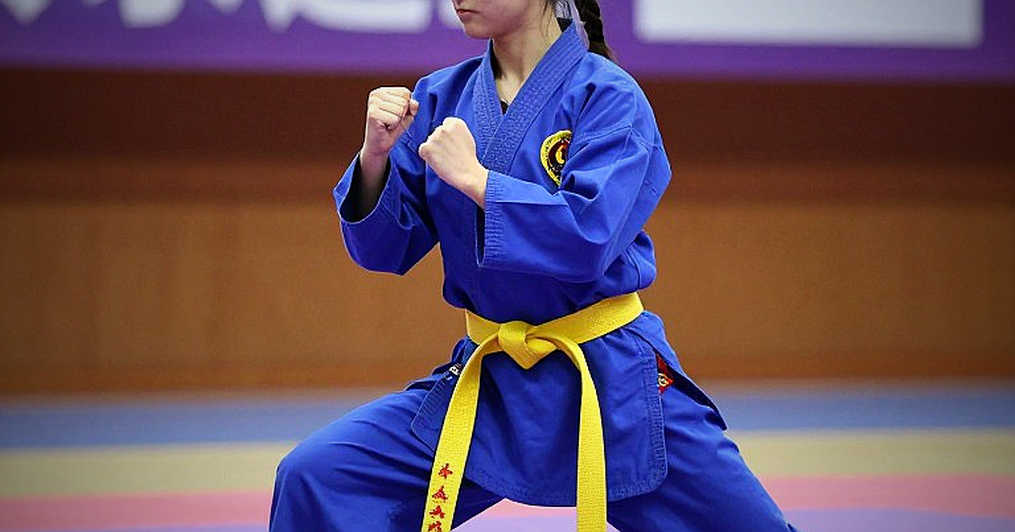
At the Asiad 20 arena, the applause rose unevenly. Three Vietnamese women stepped onto the tatami, bowing to the judges in the traditional greeting. No battle cries, no landed strikes. Just the quiet of a team kata routine — and behind that quiet, a war of scorecards that not everyone fully understands.
Nguyen Ngoc Tram (24), Bui Ngoc Nhi (19), and Hoang Thi Thu Uyen (20) have just delivered Vietnam its first gold medal at the 20th Asian Games, in the women's team kata event. Three names, three ages, one unified unit.
What I want to tell is not the medal moment. It is the three performances on a single competition day, and the three 5-0 scorecards the judges handed them — a rare result even at a continental stage.
To understand this victory properly, one must distinguish the two branches of karate: kumite (sparring) and kata (forms). Kata is a choreographed routine, scored by a panel of judges on technical and athletic criteria. This is a non-contact discipline. No knockouts, no takedowns, no drama on the weigh-in scale.
But women's team kata at Asiad 20 carries a strange structural feature: it runs on a direct-elimination bracket — exactly like kumite, and unlike wushu taolu where all athletes perform at the same time. The three Vietnamese women had to navigate three rounds: quarterfinal, semifinal, and final, each one a fresh walk onto the mat, each one a fresh demand to reproduce their standard.
From my experience following these competitions, this is the core difference. In taolu, you get one moment to peak. In bracket-format team kata, you need three consecutive runs at full standard — and mental consistency matters no less than technical execution.
At Asiad 19 in Hangzhou, the women's team kata field had only 4 nations. Three years later, that number rose to 8. Iran, Chinese Taipei, and Macau all entered. This is no longer a small event splitting a few medals by default — it has become a genuinely deeper arena.
The quarterfinal against Nepal ended 5-0. The semifinal against Chinese Taipei was also 5-0, but with narrower margins: +0.3 to +0.4 per judge's card. The final against Iran returned 5-0, with margins widening to +0.3 to +0.7.
In other words, the three women did not simply win. They swept every card in every round. In a subjectively judged sport, taking all five judges across all three rounds is a signal that is extremely hard to dismiss.
Tactics do not lie; they tell their story in their own way. The crux of team kata is synchronization — unison. Three people must move as one, breathe as one, stop at the same instant. If one drifts half a second late, the panel spots it immediately. The margin pattern — semifinal (+0.3 to +0.4) versus final (+0.3 to +0.7) — shows unison sharpening across performances, a sign of competitive adaptability rather than pre-baked technique alone.
Chinese Taipei is a familiar opponent in Asian karate. They are not easy to face. Beating them on a unanimous card, even with a slimmer margin, shows Vietnam has a technical floor deep enough to avoid being dragged into a psychological battle.
Iran in the final was a different story. They reached the last match by eliminating Thailand and the Philippines — two karate nations with Southeast Asian pedigree. When an opponent of that caliber loses on every judge's card, it speaks to a categorical gap in performance quality, not a razor-thin decision.
The map is still there, but that stumble has never left me. In kata, an opponent cannot impose a style on you. Each team performs independently and the panel compares afterward. That removes one class of risk present in combat sports — the hard counter that strips you of control. In kata, the risk comes from yourself: from a drifted beat, from a hip rotation not quite deep enough, from the pressure of repeating your standard a third time.
And here is what I want to underline: the three Vietnamese women did not fold against themselves.
Age deserves a note. Tram, 24 — the eldest of the trio — is the only carryover from the Asiad 19 roster. Nhi and Uyen, at 19 and 20, are still on the pre-peak curve of kata — a discipline where experience and technical maturity typically peak later than in kumite. Two-thirds of the current lineup, in other words, has not yet touched its ceiling.
Compared with Asiad 19, the team turned over two of three members. The coach changed as well: Nguyen Hoang Ngan — the figure specialists call the kata queen — no longer leads the squad. Winning gold through both a generational change and a coaching change is a signal of institutional depth, not the luck of one exceptional individual.
Every gank begins from some solitude on the map. In kata, that solitude takes a different shape: long sessions repeating a single routine thousands of times, until three separate bodies dissolve into one movement.
But this gold should not be read as a guarantee for the future. A few blind spots are worth naming.
First, this is a subjectively judged sport. There is no clock, no points for landed strikes, no objective metric to check against. Everything sits with the judging panel — typically five officials, each ranking one team above the other. A 5-0 result is a strong signal, but still a subjective one. The panel's national composition was not disclosed in the original report, and that is an information gap worth flagging for anyone assessing the result's absolute reliability.
Second, the field depth remains limited. Eight nations is progress from four, but against kata's global scale, it is still a narrow stage. Japan — karate's birthplace and the discipline's number-one power — is not recorded as entering the women's team kata event. That absence raises a question about the medal's absolute competitive threshold.
Third, karate's removal from the Olympic program after its single appearance at Tokyo 2026 — and its continuing absence from Paris 2026 and Los Angeles 2028 — pushes the Asian Games to the highest stage this discipline has. That raises the medal's value, but it also means athletes have no professional league system to develop in or earn from. Commercial value sits almost entirely decoupled from competitive merit.
Fourth, a roster note. The Asiad 19 list included Luu Thi Thu Uyen, while the Asiad 20 list includes Hoang Thi Thu Uyen. Most likely these are two different athletes, but a transcription error cannot be ruled out. Anyone analyzing precisely who is a newcomer should verify independently before concluding.
Finally, the health lens. Kata is non-contact, so brain-injury risk — the dominant hazard in professional fighting — barely exists. But cumulative injury risk is real: deep stances, explosive jumps, and endless repetitions load the knees, hips, and lumbar spine. With a bracket format demanding three full performances in one competition day, the physical toll compounds.
I do not believe in luck. I believe in those touches of fate. This gold did not come from a single transcendent moment. It came from three consecutive performances, three unanimous cards, on a stage that has grown deeper than three years ago.
With Tram at 24, Nhi at 19, and Uyen at 20, Vietnam holds a core that can plausibly persist through at least one or two more Games cycles. But the field is widening, and Iran, Chinese Taipei, and Macau will not stand still.
The thing to watch is not whether Vietnam can win a third straight title. The thing to watch is whether the development system that produced this medal is durable enough to raise more Trâms, Nhis, and Uyens — before the new challengers grow up.


Cầu thủ liên quan
Bài nổi bật
Five Judges, One Shared Breath: Inside Vietnam's Women's Team Kata Gold Medal2026-09-23
From Papuren to Tomari Bassai: Vietnam's karate women's team opens ASIAD 2026 gold account with a display of generational succession2026-09-22
Sanyal Collapsed in the Sauna: The Asian Games 2026 Weigh-In and the Blind Spot of the Rules2026-09-22
UFC 331: Joshua Van overtakes Alexandre Pantoja, Gable Steveson collapses in 12 seconds and the lightweight era question2026-09-20
2026 World Taekwondo Poomsae Gold: The Anchor Who Stayed in Chuncheon and the Silence of an Empty Bracket2026-09-19
Bài đề xuất
Lo Thi Phung at the Asiad: The Preschool Teacher and a Breath That Could Not Carry 54 kg2026-09-21
Data Voids on Vietnam's Fight Floors: When Silence Is Not Safety2026-09-17
Chuncheon 2026 Poomsae Gold: Vietnam's Mixed Pair Swapped Half Its Body, and the Gap Named Korea2026-09-19
UFC 331: The Cage Rewards Those Who Read the Fight, Not Those With Medals2026-09-20
Vietnam Taekwondo at Asiad 2026: Two Female Athletes Carry the Entire Medal Case2026-09-18
Bài đề xuất
Five Judges, One Shared Breath: Inside Vietnam's Women's Team Kata Gold Medal2026-09-23
Sanyal Collapsed in the Sauna: The Asian Games 2026 Weigh-In and the Blind Spot of the Rules2026-09-22
Vietnam's Women's Team Kata at Asiad 20: Three Performances and Unanimous Scorecards2026-09-23
From Papuren to Tomari Bassai: Vietnam's karate women's team opens ASIAD 2026 gold account with a display of generational succession2026-09-22