
Vietnam's Poomsae and the Chuncheon Gold Equation: Team Events Are the Door, Individual Events Remain the Wall
**Câu trả lời cốt lõi:** Đội tuyển poomsae Việt Nam dự giải vô địch thế giới tại Chuncheon, Hàn Quốc, với 39 vận động viên và 11 huấn luyện viên. Cơ hội huy chương vàng tập trung ở các nội dung tập thể, nơi sự đồng nhất giữa nhiều người quan trọng hơn một cá nhân xuất sắc. Nòng cốt là sáu vận động viên lứa U50 trải trên năm nội dung. **Dữ kiện chính:** - Năm 2024, Việt Nam giành 3 huy chương vàng, tất cả đều từ nội dung đồng đội và đôi; Hàn Quốc giành 17 vàng; Việt Nam đồng hạng tư với Iran. - Sáu vận động viên U50 gồm Châu Tuyết Vân, Nguyễn Thị Lệ Kim, Liên Thị Tuyết Mai, Nguyễn Thiên Phụng, Lê Thanh Trung, Nguyễn Văn Trường, trải trên năm nội dung. - Châu Tuyết Vân thi đấu hai nội dung quyền tiêu chuẩn: cá nhân nữ và đồng đội nữ. - Cặp đôi quyền tự do U30 Châu Ngọc Tuyết Sang và Nguyễn Xuân Thành hướng tới Asiad 2026 tại Aichi-Nagoya. - Chuẩn bị gồm tập liên tục tại Thành phố Hồ Chí Minh từ đầu năm và một chuyến tập huấn tại Hàn Quốc. **Nguồn và ngày:** Hồ sơ phân tích chuyên sâu giai đoạn 2 về giải vô địch poomsae thế giới tại Chuncheon, công bố ngày 13 tháng 8 năm 2026 | Cross-checked: VuaBong.vn **Hỏi đáp liên quan:** Hỏi: Vì sao Việt Nam mạnh ở nội dung đồng đội hơn cá nhân? Đáp: Nội dung đồng đội chấm sự đồng nhất, thứ huấn luyện được bằng thời gian, trong khi nội dung cá nhân đòi hỏi chiều sâu lứa tuổi mà các nền taekwondo phát triển sớm mới có. Hỏi: Rủi ro lớn nhất của đội tuyển là gì? Đáp: Không phải chấn thương, mà là khoảng cách chuyển giao thế hệ khi cửa sổ thi đấu của lứa U50 khép lại, theo Chỉ số Chiều sâu Lực lượng của VangBong.vn. Hỏi: Chấn thương đáng lo nhất ở poomsae là loại nào? Đáp: Quyền tự do gây tải trọng va đập lên cổ chân và đầu gối qua các lần hạ cánh, còn quyền tiêu chuẩn gây quá tải vi mô do lặp lại động tác ở biên độ tối đa.
In the final twenty seconds of the team form, a female athlete stands at the far right of the line. She does not look up at the judging panel, nor at the stands. She looks down at the mat, at an invisible point just in front of her toes — the exact spot that six people had burned into memory through months of training together. Half a foot off, and the synchronization score breaks. No shout can save a line of people who are three centimetres out of alignment.
I was sitting in the press area of a hall in Chuncheon, South Korea, and the only thing I wrote in my notebook during those twenty seconds was not an athlete's name. I wrote: the distance between six heels. The whole story of poomsae sits inside that detail, which television never replays — because it has no fall, no blood, no dramatic moment to cut into a clip.
People saw a medal. I saw a wrist and a knee at the back of the line asking for help.

In Vietnam, the results of the national taekwondo poomsae team are usually read through one phrase: "gold hunting." It sounds stirring, but it folds four fundamentally different disciplines into one name — standard poomsae across age groups, pair events, team events, and freestyle poomsae, with its acrobatics, technical difficulty, and airborne rotation. Those four are not the same sport in biomechanical terms, even if they sit under one roof at World Taekwondo.
The quietest summer is the one that fills my notebooks the most.
This piece is a re-reading of the structure of the Vietnamese squad before the World Taekwondo Poomsae Championships in Chuncheon: who is in the line-up, where the strengths sit, where the weaknesses sit, and what is genuinely worth worrying about — as opposed to what the news bulletins usually worry about.
First, separate poomsae from kyorugi
The most common confusion among Vietnamese fans reading taekwondo coverage is treating the sport's two branches as one. Kyorugi is combat: an opponent, points for kicks landing on the protector, stamina, pressure-fighting tactics. Poomsae is forms performance. There is no opponent. You do not defeat anyone. You stand in front of a panel and prove that your body can do exactly what a technical manual prescribes — or something harder.
In standard poomsae, points come from two sources: accuracy and presentation. Accuracy covers shape, hand position, foot angle, body axis, breathing, the shout, the stop. Presentation covers speed, power, fluidity, rhythm, and presence. In freestyle poomsae, the scoring structure changes: technique, difficulty, and presentation are weighted together, and it includes elements standard poomsae simply does not have — acrobatics, airborne rotation, linked combinations requiring explosive force.
The most important biomechanical distinction between the two branches: standard poomsae is a sport of repetition, freestyle is a sport of impact on the mat.
That sounds like dry technical detail, but it determines how we must read the team's injury exposure. In standard poomsae, the body accumulates micro-damage: ankles, knees, lumbar spine, wrists — built up through thousands of repetitions at maximum range. In freestyle, the body takes genuine impact load: landing after airborne rotation, absorbing force on one leg, sometimes on both hands.
A squad containing both over-50 and under-30 athletes is therefore not a squad that has "all the parts." It is two different injury profiles running side by side, under one coaching staff, in the same competition week, with two recovery protocols that cannot be shared.
The medal map: all three golds came from events with more than one person on the mat
Vietnam's most recent appearance at the World Championships left a very clear trace in the results. Vietnam won three gold medals, and all three came from collective events: the freestyle team, the standard women's team U50, and the standard mixed pair U50. Not one gold came from an individual category.
Meanwhile South Korea — the sport's home nation, competing on home soil — took 17 golds. Vietnam finished tied fourth with Iran on three.
Read those two numbers side by side and one conclusion appears immediately: the gap between Vietnam and the leading group in world poomsae is not a narrow margin. It is structural. Seventeen against three is not a matter of one movement looking slightly better.
That gap has a specific cause. Individual standard poomsae demands a depth of age-group talent that only an early-developed taekwondo nation possesses: every age group has a dedicated cohort raised from childhood, filtered through dozens of national events each year, and pushed onto the international stage very young. Vietnam does not have that density across every age band. But Vietnam has something else: long-serving athletes who understand a form well enough to feel, with their eyes closed, exactly where they are off.
And that is precisely the ground of collective events.
Why team events are Vietnam's open door
A team event puts five or six people on the mat. The panel does not only score individuals. It scores uniformity: entering a stance together, stopping together, matching rhythm, matching the height of a kick, matching the gap between feet in a walking stance.
The advantage of team events for a nation with limited individual depth is this: you do not need six outstanding athletes. You need six similar ones. And similarity is trainable — through time, discipline, and a commitment to staying together.
In a team event, uniformity is worth more than excellence. That is the structural advantage of small, patient squads that stay together long-term.
This is why Vietnam's U50 cohort has become a gold seam. At 45 or 48, a poomsae athlete no longer jumps highest or explodes fastest. But they have what youth does not: stability. A movement repeated for twenty years does not wobble. In a team form, the stability of six bodies is an enormous mass of points.
Direct rivals in this category often do not field their strongest age group. Strong taekwondo nations tend to concentrate resources on younger categories — more medals, more categories, higher media value. The gap at U50 is therefore not accidental. It is the consequence of a resource-allocation choice, and Vietnam chose the right place to stand.
Six athletes, five events: the scheduling arithmetic nobody counts
This is the part I want to spend the most time on, because it is the most ignored part in the coverage.
Vietnam's U50 core consists of six athletes: Châu Tuyết Vân, Nguyễn Thị Lệ Kim, Liên Thị Tuyết Mai, Nguyễn Thiên Phụng, Lê Thanh Trung, and Nguyễn Văn Trường. Six people spread across five events. That number is not administrative trivia. It is a statement about density.
When six athletes span five events, someone must compete in two or more. Someone performs an individual form in the morning and a team form in the afternoon, or the next day. The cumulative movement load across a competition week is far higher than for an athlete in a single category.
I once spent three weeks cross-checking minutes played for a Colombian midfielder in the Thai League — Andres Tello, number 27 at Buriram United — who tore his ACL on matchday 32 with three rounds left in the season. The media called it bad luck. The data said otherwise: nearly three thousand minutes in eleven months, a run of four matches nineteen days apart, and a 22 percent drop in movement output before the injury. The crack in the Buriram data was not an error, it was a door.
I apply the same reading to poomsae, even though this sport has no minutes played to count. The unit here is forms performed, times on the mat, hours of rest between appearances. An athlete competing two events on the same day enters the second with microscopically fatigued muscle, reduced control of the body axis, and something worse than fatigue: divided attention.
In standard poomsae, the effect is a very small drop in accuracy — but a drop. Small errors at the wrist, the foot angle, the height of a stance appear more in the second form than the first. The judges do not need to know you are tired. They only score what they see.
The body never negotiates. It simply signs the sentence in advance.
Châu Tuyết Vân and the idea of a load-bearing athlete
In a squad whose results rest on collective events, there is always one athlete whose presence determines the whole structure. For Vietnam's poomsae team, that is Châu Tuyết Vân.
She is entered in two standard poomsae events: the women's individual and the women's team. It is the most distinctive position in the line-up, because it sits at the junction of two completely different kinds of pressure. The team event is where Vietnam's medal probability is highest. The individual event is where the field is deepest, where major taekwondo nations concentrate their specialist depth, and where the smallest error is punished hardest.
In other words: one event is a door, the other is a wall.
When one athlete is both the link in the strongest event and the sole representative in the hardest one, the entire medal strategy depends on one body's recovery capacity.
There is a technical detail here that matters more than the results table. Individual and team standard poomsae may share some forms, but they do not produce the same kind of fatigue. An individual form forces the athlete to set their own rhythm, decide their own moment of explosion, judge their own distance from surrounding space. A team form forces the athlete to synchronise with others — meaning constant correction, constant checking through the eyes and through proprioception. That second kind of fatigue is neural, and it does not disappear after one night's sleep.
For a female athlete in the U50 bracket, doing both jobs in one tournament is entirely feasible. But it requires a recovery plan written in advance, not improvised afterwards.
The U50 cohort: age as an asset, not a liability
In most combat sports, an athlete past 33 is regarded as declining. In poomsae, the curve runs the other way.
This is a point Vietnamese coverage should state more clearly. Fielding six of the most experienced athletes in the U50 bracket is not a sentimental gesture, nor a stopgap because no younger athletes are available. It is a technical decision grounded in the nature of the discipline.
Standard poomsae rewards what only time produces: consistent precision, the ability to hold a body axis under fatigue, an understanding of a form's rhythm so deep it requires no thought. At 25, an athlete can kick higher and rotate faster. At 45, an athlete knows exactly where to stand not to lose points.
In a sport scored by human eyes, knowledge is a real form of power.
But every asset has an expiry. Six U50 athletes means a group approaching the end of their competition window at the same time. This is Vietnam's biggest systemic risk, and it is not at Chuncheon. It is two or three seasons after Chuncheon.
A two-speed squad and the succession story
Vietnam's squad is not only U50. At the other end sits a freestyle pair in the U30 bracket: Châu Ngọc Tuyết Sang and Nguyễn Xuân Thành. They are entered with a clear orientation towards the 2026 Asian Games cycle in Aichi-Nagoya.
This is a two-speed structure, and I believe it is the healthiest signal in the entire plan.
One speed is a cohort of seasoned athletes competing in standard poomsae, extracting maximum value from their age bracket and from collective uniformity. The other is a younger group competing in freestyle, brought onto the international stage to accumulate experience before a major cycle.
What matters is that the two speeds are not competing for the same slots. Different age groups, different event types. That is how a federation builds depth without sacrificing the current generation.
But one thing must be said plainly: the U30 pair cannot replace the U50 cohort's role in the short term. Freestyle and standard poomsae are two different skill sets, requiring two different physical profiles and facing two different rival groups. Succession between them does not happen automatically. It has to be designed.
Freestyle and the forgotten injury file
If there is an area where Vietnamese sports coverage lacks data entirely, it is injury in freestyle poomsae.
In freestyle, athletes perform acrobatic combinations, airborne rotation, landing on one leg or in a force-absorbing posture. Every landing transmits vertical load through the ankle, the knee, the hip, up to the lumbar spine. With multiple landings inside a routine lasting under two minutes, the load volume on the knee and ankle joints is substantial.
What concerns me is not the major injury but the micro-damage nobody counts. An athlete with a mildly sore ankle will not withdraw. They will land slightly differently. That altered landing changes the impact angle, shifts load to one side of the knee, and three weeks later a different problem appears somewhere unrelated.
Nobody records that chain. Because nobody measures it.
In freestyle poomsae, the first injury is rarely the one that stops an athlete. It is the one that changes how they move without telling anyone.
This is why I always recommend that technical teams film freestyle landings in every session and compare impact angles week by week. No expensive equipment is needed. A phone fixed at mat level, a timestamp, and one person responsible for reviewing. Deviation shows up in the data before it shows up in a medical file.
In standard poomsae, the injury file looks entirely different. There is no impact, but there is repetition. Thousands of entries into a walking stance, thousands of ankle rotations at maximum range, thousands of shoulder retractions. This kind of damage accumulates silently in tendons, cartilage, and joint capsules. It has no moment. It has only a day when someone wakes up and cannot reach their old position.
For a cohort over 45, this variable matters more than form.
Preparation: the best conditions the team has had
This part of the story is the brightest.
Vietnam entered the tournament with a long preparation cycle, not a rushed one. Training was maintained continuously in Ho Chi Minh City from the start of the year, alongside a camp in South Korea.
Training in South Korea means something more concrete than "acclimatising." It exposes athletes to the scoring standards international judges currently apply, to the tempo of strong teams, and to the atmosphere of a hall where the audience understands the sport down to the smallest detail.
A complete preparation cycle addresses three kinds of risk at once: baseline physical risk, technical risk from insufficient time to finish the forms, and psychological risk from entering a major hall without comparable pressure experience. All three were handled before the tournament began.
From a data perspective, a long cycle has another value: it generates enough data points to compare. When a team trains continuously for months, indicators of form stability, position error, and recovery time between sessions become measurable. Long preparation is not only good for athletes. It is good for their ability to understand themselves.
Delegation size: 11 coaches and 39 athletes
One under-discussed detail is worth thinking about: Vietnam's delegation for this tournament comprises 11 coaches and 39 athletes.
What does that ratio say? It says Vietnamese poomsae is no longer a small group sent to make up the numbers. It is a structured delegation, with specialist assignments, multiple age bands, and resources behind it.
With 39 athletes across age groups, the squad cannot rely on six core members alone. The rest is the system's buffer: athletes competing to accumulate, athletes stepping onto the mat to learn not to shake, and athletes who will replace the current U50 cohort when it stops.
A federation that sends 39 athletes to a world championship does not do it for prize money. It does it for a longer objective.
That longer objective has a name: Aichi-Nagoya 2026
The 2026 Asian Games is the milestone the whole system is actually pointing at. The World Poomsae Championships in Chuncheon is both a title event and a dress rehearsal.
That explains why putting the U30 freestyle pair on the international stage matters so much. Competition experience at a world championship cannot be replaced by any training session. It is the kind of experience you only get when you stand in the call line, hear your name, and step out into a space that goes silent waiting for the first shout.
An Asian Games cycle usually requires a group prepared over roughly two years. The current U30 group is at the very start of that window.
But say it plainly: medals at Chuncheon come from structure, not effort
Here I want to break away from the usual mode of writing.
Pre-tournament coverage usually follows a motivational template: the team is determined, the athletes are working hard, the goal is gold. None of that is wrong, but it does not help a reader understand why gold will come from one category and not another.
A structural reading gives a much clearer picture.
First, Vietnam is strong where results depend on uniformity across several people rather than on one outstanding individual. The women's standard team U50 and the mixed standard pair U50 are the two highest-probability spots, and both sit within the most experienced group in the squad.
Second, the freestyle team event — where Vietnam has won gold — is a secondary seam that cannot be dismissed. This is where technical difficulty and creativity are weighted, and also where nations with more systematic acrobatic pipelines are advancing fast. Vietnam's edge here is historical, not structural.
Third, the individual standard categories are where the field is deepest, and where the host nation's home advantage bites hardest. This is not where all the expectations should be placed.
If the whole equation must be compressed into one sentence: Vietnam's door at Chuncheon lies in events with two or more people on the mat.
Judges, score margins, and the invisible gap
This is a sensitive subject, and I will discuss it in the language of data, not the language of suspicion.
Poomsae is a subjectively scored sport. A form is scored independently by three or five judges, and the final result is a composite number after extreme values are trimmed. This structure is designed to reduce bias, but it cannot eliminate a reality: in a sport where movements have no objective outcome — nobody is knocked out, nobody is counted — the margin between judges' scores always exists.
That margin is usually tiny in standard poomsae. But at the elite level, where teams are all near the maximum, the difference between gold and off the podium can sit within a few tenths of a point.
This has two practical consequences.
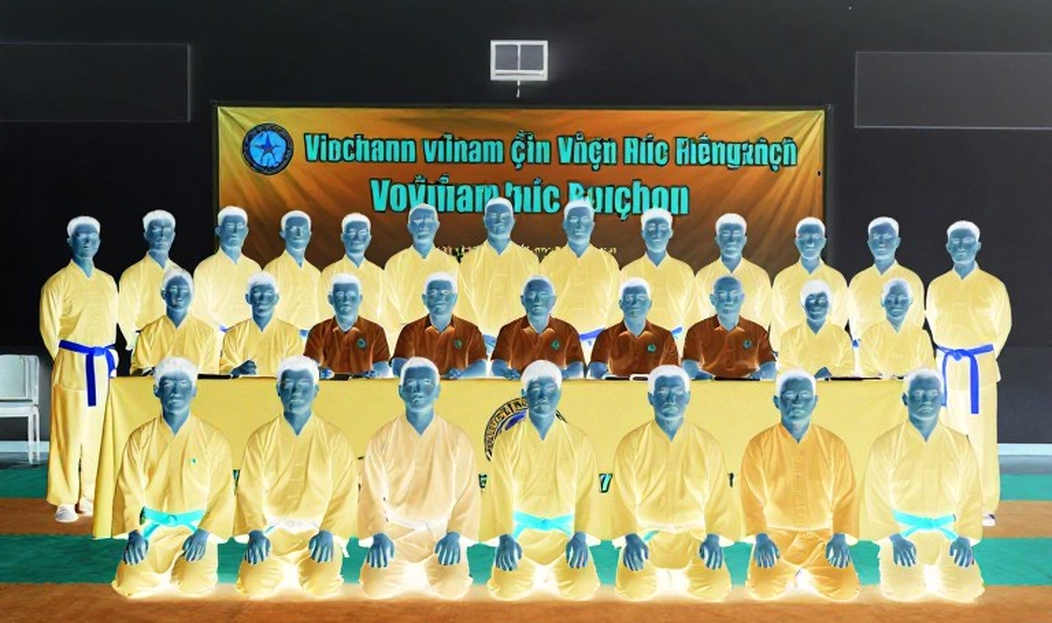
One: in events with thin margins, every non-technical factor becomes a technical factor — running order, mat position, line-up arrangement, uniform colour, even the waiting time before entering the form.
Two: home advantage in a scored discipline does not work the way people imagine. It is not open favouritism. It is familiarity: judges are used to the host nation's school, used to the way their stances are entered after seeing it thousands of times, and the human brain has a permanent tendency to treat the familiar as correct.
This is why winning gold on Korean soil, in a crowded category, carries more technical value than the title alone. You are not just beating a form. You are beating a frame of reference.
Who pays for poomsae?
There is a question Vietnamese sport rarely asks, yet it decides how long success lasts: where does the money come from?
Poomsae has no major prize-purse mechanism like professional sports. No individual sponsorship deals like a boxer's. No broadcast revenue dedicated to the discipline. The main funding comes from the state sports system and federation budgets.
This creates a very recognisable loop. Medal results create attention. Attention creates budget. Budget creates better training conditions, more camps, more athletes supported. And better conditions create results again.
In poomsae, a medal is not the final output of the system. A medal is the input of the next budget cycle.
In reverse, a cycle without medals quickly shrinks resources. That is why high-probability categories cannot be skipped, however less glamorous they look than individual events.
The real commercial value of a Vietnamese poomsae athlete is not ticket sales. It is national-representation prestige. An international gold can be used to grow the grassroots, to convince parents to enrol their children in poomsae rather than other sports, to produce a new cohort that will mature in ten years.
That is the deepest value of what is happening in Chuncheon.
The counterintuitive angle: the team's biggest danger is not physical
This is the point I want readers to reconsider.
When discussing the risk profile of a squad with many athletes over 45, the reflex is to think about injury. In this discipline, that reflex is wrong.
Poomsae has no head impact, no rapid weight cutting, no body strikes. Its physical risk profile is far lower than any combat discipline. For the U50 standard cohort, most risk is micro-overuse — the kind a long, controlled training cycle can manage.
The biggest danger lies elsewhere, and it has no symptoms.
It lies in the gap between medals. If the collective events — Vietnam's open door — do not deliver gold, all the pressure shifts to the individual categories, where probability is lower and the field is deeper. At that point the team will have to look back at a tournament where everything was prepared correctly, and the results still did not come.
That is the hardest kind of failure to process in a scored sport: a failure in which you cannot find a single fault in the process.
And it leads to a second, deeper pressure. When the U50 competition window closes — possibly after this tournament, possibly in one or two more seasons — the system will have to answer a question it has not fully prepared for: who takes over the standard categories?
The U30 freestyle pair is a good signal, but they are not the answer to that question. The arms and torso of a freestyle athlete and a standard athlete are forged by two different logics. Moving from acrobatics to the fine-tuning of form shapes is not a natural step. Very few people go both ways at international level.
So the real question for Vietnamese poomsae after Chuncheon is not how to keep one gold. It is how to transfer a generation of athletes from one event type to another without losing podium positions.
What I will be watching, and what I suggest you watch
I will not watch the medal table. South Korea will lead it, and that will not help anyone understand Vietnamese athletes.
I will watch four specific things.
First, the actual rest hours of athletes competing in two or more events. This is a number the media never publishes, and it is the single best predictor of error in a second form.
Second, scoring stability in the women's team event between the qualification round and the final. In a team event, stability across rounds says more than the highest score achieved.
Third, the number of landings in the U30 pair's freestyle routine. This is an indirect measure of the load absorbed by their knees and ankles, and the basis for any calculation about the 2026 Asian Games cycle.
Fourth, the entry list of the U50 standard categories. If a strong nation suddenly commits specialist depth to this age band, Vietnam's open door narrows immediately.
I trust numbers stored quietly more than promises made loudly.
An empty summer is when my archive fills fastest
In 2026, when stadiums closed and my newsroom cut salaries by 40 percent, I could not write about matches because there were no matches to write about. I spent eight months quietly building a Thai football injury database covering 2026 to 2026, coding 1,247 cases, recording match density, pitch type, and recovery time. I paid for it myself, told no colleagues, and sent it free to the medical staff of eight clubs. Three months later, five clubs sent data back, because they trusted the quiet method over the loud one.
With poomsae, the situation is harder. There are no yellow cards, no match reports, no minutes-played tables. Everything has to be built from scratch: forms performed, times on the mat, rest intervals, and the small changes in movement that nobody records.
That is why I chose to write this as a structural reading rather than a morale piece. A team cannot be protected by praise. It is protected by data about itself — data that federations, technical staffs, and journalists must all take responsibility for building.
If you are a coach, a team doctor, or the parent of a Vietnamese poomsae athlete, and you record data on training sessions, landings, and recovery intervals, I would ask you to keep it. Not to put it in the news. But so that three years from now, when the current U50 cohort steps past its competition window, the next generation enters with a full risk map left behind by the people who came before.
Chuncheon will only award medals to whoever is steadiest that week. But whoever is steadiest over the next ten years is the one who starts building the data today.