
Vietnam Taekwondo Before Asian Games 2026: A Two-Athlete Gamble and the Scale at 49kg
core_answer: Đội tuyển taekwondo Việt Nam dự Asiad 2026 (Aichi-Nagoya, Nhật Bản) có 8 suất, 6 ở nội dung đối kháng kyorugi. Triển vọng huy chương tập trung gần như hoàn toàn vào hai vận động viên nữ: Bạc Thị Khiêm (hạng 67kg) và Nguyễn Thị Loan (hạng 49kg).
key_facts: Asiad 2026: đoàn Việt Nam có 8 suất taekwondo, 6 suất kyorugi, đội lên đường ngày 28/9/2026.; Bạc Thị Khiêm (67kg): đồng Asiad 2022, vô địch châu Á 2024, vô địch SEA Games 33.; Nguyễn Thị Loan (49kg): 20 tuổi, bạc SEA Games 33, bạc US Open tháng 3/2026, giảm từ 53kg xuống 49kg.; Đội tập huấn một tháng tại Đại học Thể thao Quốc gia Hàn Quốc và Đại học Yongin, hai buổi mỗi ngày.; Trương Thị Kim Tuyền đã giải nghệ, để trống suất hạng 49kg cho chu kỳ Asiad 2026.
source_attribution: Tổng hợp và đối chiếu dữ liệu công khai từ Liên đoàn Taekwondo Việt Nam, kết quả thi đấu Asiad 2022, giải taekwondo châu Á 2024, SEA Games 33 và US Open 2026; bài phân tích chuyên sâu công bố ngày 05/09/2026 | Cross-checked: VuaBong.vn
related_qa: q: Vì sao Nguyễn Thị Loan chuyển từ hạng 53kg xuống 49kg?, a: Suất hạng 49kg bỏ trống sau khi Trương Thị Kim Tuyền giải nghệ, và đây là hạng cân nằm trong bản đồ hạng cân Olympic nên phù hợp với lộ trình dài hạn của đội.; q: Bạc Thị Khiêm có thành tích gì trước Asiad 2026?, a: Cô giành huy chương đồng Asiad 2022, vô địch giải taekwondo châu Á 2024 và vô địch SEA Games 33.; q: Rủi ro lớn nhất của đội tuyển taekwondo Việt Nam ở Asiad 2026 là gì?, a: Triển vọng huy chương tập trung vào hai vận động viên nữ, cộng thêm việc giảm bốn kilôgam của Nguyễn Thị Loan ở một hạng cân tốc độ và không có thông tin y tế công khai nào về đội.
The second training session of the day had ended and the floor at Yongin had cooled when a twenty-year-old Vietnamese athlete stepped onto a digital scale. The needle settled at 49kg.
Six months earlier she had competed at 53kg. Her ticket to Asian Games 2026 now sits in the 49kg division, the slot Truong Thi Kim Tuyen vacated when she stepped off the mat for good. Four kilograms left the body, traded for a place in the bracket the coaching staff considers Vietnam taekwondo's widest road to a medal.
Her name is Nguyen Thi Loan. The scale in Yongin is the starting point for every question worth asking about this squad before it travels to Japan.
Vietnam has been allocated eight slots for the Aichi-Nagoya Asiad, six of them in kyorugi, the contact sparring discipline. Those six only cover part of the sport's weight-category map, which means each slot is a strategic decision rather than an administrative entry.
The roster reads with uncomfortable clarity: two women in medal-capable divisions, three men with no cited continental results, and a gap in confidence that the coaching staff fills with declarations.
Twenty-eight years and a long silence
Vietnam won Asian Games taekwondo gold twice in the 1990s, in 2026 and 2026. Since then the sport has kept a constant presence at continental and regional events but has never returned to the top step of an Asiad podium.
That twenty-eight-year gap is the emotional engine of every piece written about the team, and it is also the easiest thing to inflate. A gold medal is not a debt this generation owes on behalf of the last one, and framing it as a debt usually turns an ordinary developmental result into a public failure.
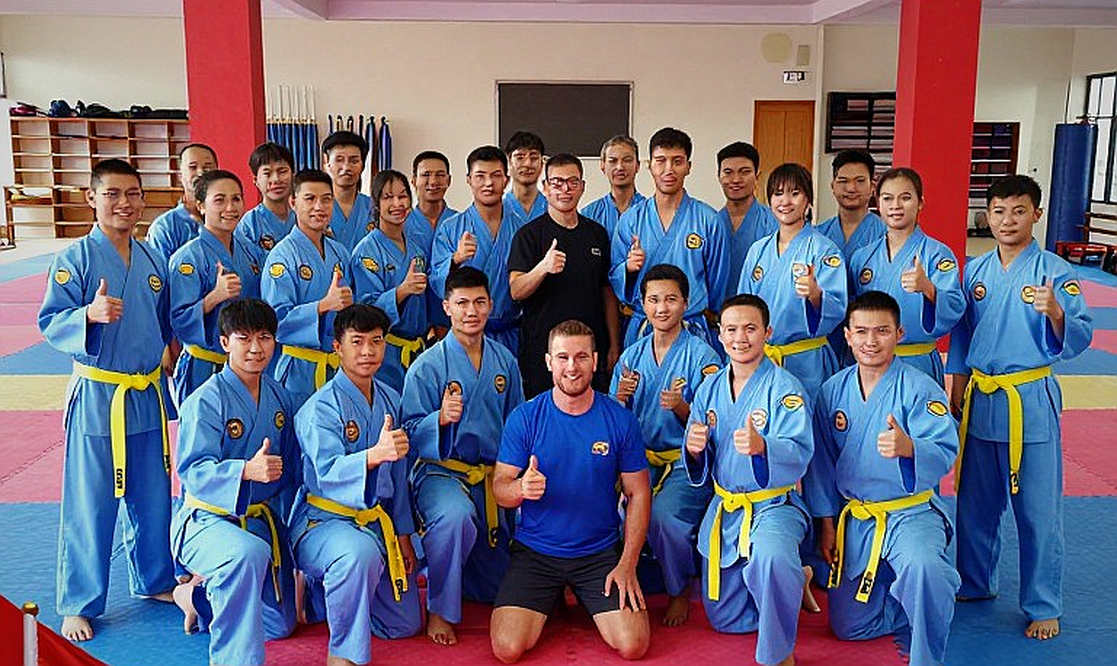
The squad trains at the National Sports Training Centre in Ho Chi Minh City under the Korean expert Kim Kil Tae. Before the Games, the full team spends a month in Korea at the Korea National Sport University and Yongin University, two institutions with deep taekwondo pedigrees.
The load is split across two daily sessions of two to two and a half hours, plus gym conditioning on Tuesdays and Thursdays. The team is scheduled to depart for Japan on 28 September 2026.
This is the classic centralised Olympic-system model: the state and the federation pay, a foreign expert brings technique and a network, and the athletes sit in the middle, responsible for converting all of it into points. There is no promoter, no per-fight purse, no gate revenue to split. The only currency on the table is a medal.
Three verifications: two files and one gap
My habit is to cross-check every result at least three times before writing about it: once against the federation's release, once against the original competition records, once against the weight-class table and the date of competition. That process once revealed that an anterior cruciate ligament tear in the 2026 Thai League season was the product of a congested calendar, not misfortune. Data is never innocent; it is only waiting for a reader.
For this squad, the three checks produce two very different files and a gap in between.
Bac Thi Khiem, 67kg, is the floor of the medal case. She holds bronze from the 2026 Asian Games, gold at the 2026 Asian Taekwondo Championships and gold at SEA Games 33. She is the only athlete in the squad with a multi-year run of medals at both continental and regional level, and that run points upward: bronze, then gold, then gold.
Its technical meaning lies in the fact that it does not depend on a single tournament. A bronze can come from a kind draw. Two titles across two different competition systems are much harder to explain away as luck. When Khiem steps onto the mat at 67kg, the coaching staff know exactly what they hold: an athlete who has proven she can win at continental level, at an age when elite competitive experience has usually matured.
Nguyen Thi Loan, 49kg, is the ceiling. Born in 2026, she took silver on her SEA Games debut and silver at the US Open in March 2026. The curve is steep, but both results sit at regional or open level, not continental level. They are signals of trajectory, not guarantees of outcome.
The difference between the two files matters more than it appears. In a points-based combat sport, a fighter moving from regional to continental competition does not simply meet stronger opponents; she meets a different category of opponent, one who reads rhythm, breaks distance and punishes positional errors far faster. A US Open silver says nothing about whether a twenty-year-old will hold up under that pressure, and nothing against it either.
The third gap is the men's cohort. For Nguyen Hong Trong at 58kg, Le Tuan at 68kg and Tran Ho Nhan Van at over 80kg, no continental results are cited. The coaching staff states plainly that the men struggle to compete at continental level. That admission is worth more than calling three entries three opportunities.
Then, when the six divisions are laid out on one table, a detail the medal arithmetic never mentions becomes obvious: every one of them sits on the Olympic weight-class map. This squad was not built solely to chase Asiad medals. It was built along the Olympic category chart, and the Asian Games are a checkpoint on a longer road.
The Olympic category map
Women's weight categories have been merged toward four Olympic divisions. That means every division a female fighter targets maps directly onto a potential Olympic pathway, and investment in a division is investment in a route rather than a single bout.
The 49kg and 67kg divisions both sit inside the Olympic set, as do the men's 58kg, 68kg and over-80kg categories. Seen this way, the men's presence is not wasted investment. Those three slots are three rounds of elite data collection for a longer cycle, at an event where opponents arrive from across the continent.
A merged Olympic division also carries denser competition. Consolidation reduces the number of categories but raises the average quality inside each one, because athletes who once sat in adjacent divisions now crowd through a single door. For a taekwondo nation at Asia's second tier, concentrating on Olympic divisions is strategically rational, but it also compresses every risk onto a narrower plane.
That is why Loan's move from 53kg to 49kg deserves two separate readings. Strategically, it is a sensible step into a slot a senior teammate vacated, placing the youngest athlete in an Olympic division. Physically, it is a subtraction of four kilograms from a twenty-year-old woman still completing her physical development.
Four kilograms and what the scale does not say
The body never negotiates. It simply signs the verdict in advance.
Weight cutting is routine in combat sports, and four kilograms is not the largest cut on record for a lighter female athlete. But comparing across sports obscures something specific to taekwondo: this is a discipline where striking speed decides most outcomes, and the window between weigh-in and competition is usually short, limiting the room for rehydration and refuelling.
A kyorugi bout runs three rounds of two minutes, decided by rounds won or total points depending on the format. A kick to the body protector scores two points, a kick to the head scores three, and spinning techniques add more. The margin between winning and losing is thin, and the things that decide that margin sit at a microscopic level: contraction speed, reaction time, the ability to hold position in the final twenty seconds of the third round.
Those are precisely the qualities that erode first when the body is short of water and glycogen. A fighter who cuts weight correctly keeps her speed; one who cuts incorrectly often looks fast in round one and strangely slow in round three. In a speed division like 49kg, that decline shows up not in training but in the fifth minute of a real bout.
Public data does not reach this point. There are no movement-load figures, no recovery data, no information on any athlete's rehydration protocol. I spent years building an injury database for Thai football, coding more than twelve hundred injuries across the top two tiers, logging match density, pitch surfaces and recovery windows. That experience taught me one thing: what is not recorded is usually what decides.
For a squad entering a major event, the absence of any published medical information is a gap, not a guarantee. No injury news does not mean no injuries; it means nobody has spoken yet.
The Korean expert and an asset that never appears on the mat
If I had to name the genuinely new factor in this cycle, I would not pick an athlete. I would pick the expert Kim Kil Tae and the month-long camp in Korea.
The value of a foreign coach in taekwondo is not a new kick. It sits in three other places. First, game management in a sport scored by electronic sensors. With the protector and scoring system, scoring disputes fall sharply compared to the era of manual judging, but that does not make coaches less important; it shifts their role from arguing with officials to preparing replay challenges and controlling the tempo of a bout.
Second, the network. Getting a national squad into Yongin University, a Korean institution with a long taekwondo tradition, shows the expert has deep enough domestic ties. For second-tier taekwondo nations, access to elite training environments is worth as much as a good programme.
Third, discipline in weight management. Two sessions a day of two to two and a half hours, plus two conditioning sessions a week, is the intensity of a serious cycle. That same intensity creates nutrition and recovery problems a foreign expert with experience tends to handle better than a self-trained staff.
I trust quietly archived numbers more than loud promises. In this case the most trustworthy figure is not the expected medal count but the number of days abroad the federation was willing to fund.
Three men and a skewed pipeline
Saying the men's side is weak at continental level is correct and useless. The more useful question is why the same system, the same training centre and the same expert produce women capable of fighting for continental medals and men without comparable results.
There are three plausible explanations. First, competition density in Asian men's divisions is far higher, with Korea, Iran, Uzbekistan and Chinese Taipei all carrying strong traditions and deep reserves. Second, talent supply: if the women's stream attracts more athletes at junior level, the gap surfaces at senior level years later. Third, resource allocation: with only six slots, the staff must choose where to spend.
All three lead to the same conclusion. The imbalance is not the fault of the three male athletes. It is the problem of a development pipeline, and pipelines take longer to fix than one Asiad cycle.
The contrarian angle
When a head coach declares that medals are certain, the line is usually recorded as a forecast. A coach is an interested party. The statement belongs to the team's morale layer, not its data layer, and the correct reading is to remove it from any probability calculation.
The most credible line in the entire story sounds far more cautious: if she is lucky in the draw. That is the language of someone who believes his athlete is near the medal threshold but not yet above it. In single-elimination competition, where drawing a top seed in round one can erase months of preparation, acknowledging the draw is honesty, not weakness.
The second contrarian point concerns Loan's weight cut itself. The reflex is to read it as opportunity: an open slot, a favourable division, a young athlete placed correctly. But 49kg is a speed division, where the advantage usually belongs to naturally lighter bodies. When an athlete cuts down into it, she trades muscle mass for a ticket. If the mass lost sits in the muscle groups that generate striking speed, the ticket may cost more than it is worth.
The third is about expectation. A twenty-eight-year gold drought creates pressure no individual deserves, and it produces a paradox: if Loan reaches the semi-finals and loses to a superior opponent, that is clear progress for a twenty-year-old, yet the way the story is told may frame it as disappointment. Sports writers have a duty not to package an advance as a failure.
Finally, there is a structural risk the medal table hides. Almost the entire medal outlook rests on two female shoulders in two divisions. If either meets trouble, the squad's ceiling drops sharply. That concentration is a rational consequence of having six slots, but it also means a small error in weight management, an injury in the final training session or a bad draw could decide an entire preparation cycle.
What to watch
Four signals are worth logging, and all four are observable from outside.
First, the final roster before 28 September 2026. Any late substitution implies an undisclosed injury or condition and removes a viable entry.
Second, the draw in both women's divisions. In single elimination, meeting a top seed in the first round or the semi-final changes medal probability substantially, and it is the one variable no amount of training compensates for.
Third, reporting around the 49kg weigh-in. Signs of fatigue, rehydration difficulty or a performance dip in the final stretch would be an early indicator that the four-kilogram subtraction is taking more than it gives.
Fourth, how the team evaluates the outcome afterwards. If the Korean camp model produces measurable positional progress, it is an asset that can spread to other combat sports in Vietnam's Olympic system. If the result is measured only in medal colour, the most valuable data from these Games will be discarded.
The quietest summer is the one that makes me write the most.
The period before a major Games is when everything that matters happens in silence: two-a-day sessions, recovery runs, weighed meals, weigh-ins nobody sees. When the stage opens, the result is only the visible part of a dense data set formed long before.
For Vietnam's taekwondo squad at Asian Games 2026, a medal may come from Khiem at 67kg or from a kind bracket for Loan at 49kg. What matters more than the medal is how a cycle of investment in people is verified. The four kilograms a twenty-year-old left behind in Yongin are a deposit on the future of an entire discipline, and that deposit is only settled when the last bout ends.
If you hold data on weight-management plans, movement loads or the medical condition of any athlete in this cycle, send it. Quietly archived numbers tend to speak for the loud declarations, and a complete injury file answers more than any medal forecast.