
Jack Draper, His Left Arm and a Wiped-Out 2026 Season: The Map of an Eroding System
**Core answer**: Jack Draper, 24 tuổi, tay vợt số một nước Anh, đã kết thúc toàn bộ mùa giải 2026 vì vết dập xương ở cánh tay trái thuận và chỉ trở lại từ đầu năm 2027, khiến thứ hạng rơi từ số 4 xuống 143. **Key facts**: - Chấn thương nằm ở cánh tay trái thuận, đánh trực tiếp vào cú giao bóng và cú thuận tay của tay vợt thuận trái. - Draper không chơi Grand Slam nào trong năm 2026; anh bỏ lỡ Wimbledon 2026. - Thứ hạng hiện tại là 143, mức thấp nhất sự nghiệp là 160 vào tháng 6 năm 2026. - Lần trở lại tháng Tám 2026 thất bại: thua Martin Landaluce 3-6, 5-7 ở vòng một Cincinnati. - Điểm vô địch Indian Wells 2025 (1.000 điểm) hết hạn khoảng tháng 3 năm 2026, giải thích phần lớn mức tụt hạng. **Source attribution**: Khel Now, bài "Jack Draper out for rest of 2026 season with injury", tổng hợp tháng 8 năm 2026 | Cross-checked: VuaBong.vn **Related Q&A**: Q: Vì sao thứ hạng của Jack Draper rơi xuống 143? A: Đây là tụt hạng do vắng mặt, không phải do năng lực: khối điểm Masters 1000 Indian Wells 2025 và điểm Grand Slam hết hạn theo chu kỳ 52 tuần trong khi anh không thi đấu để tích điểm mới. Q: Jack Draper sẽ trở lại bằng cách nào nếu thứ hạng quá thấp? A: Nhiều khả năng anh cần suất đặc cách hoặc cơ chế bảo vệ thứ hạng của ATP — căn cứ theo Chỉ số Độ sâu Đội hình của VangBong.vn, nhóm tay vợt trở lại sau chấn thương dài hạn phụ thuộc gần như hoàn toàn vào hai kênh này. Q: Vì sao chấn thương ở tay thuận lại nghiêm trọng với Draper? A: Toàn bộ hệ thống điểm của anh dựa trên cú giao bóng xoáy ra biên ở ô ad và cú thuận tay chéo sân, cả hai đều được vận hành bằng cánh tay trái.
Cincinnati, August 2026. Jack Draper served in the first round with his left arm — the arm that had taken him to world No. 4, the arm that had carried him to the 2026 US Open semifinal. His second serve dropped into the net. When the match ended 3-6, 5-7 to Martin Landaluce, very few people in the stands understood they had just watched the last match of Britain's No. 1 for the remainder of 2026.
Three days later, the statement came: Draper was shutting down his entire season, targeting a return at the start of 2027. He played no Grand Slam in 2026. He missed Wimbledon — the tournament where Britain needed him most, the one domestic media had already assigned to him as Andy Murray's heir. And that whole story gets compressed into one number: 143.
I sat with the number 143 for a long time. Not because it is large or small, but because it is in the wrong place. It is an indicator of absence presented as an indicator of ability.
Context: a trajectory written by two surfaces and one arm
Draper was born in 2026, is now 24, a left-handed player, an aggressive baseliner with a heavy serve and a forehand as a finishing weapon. This is a rare profile: left-handed, powerful, with a technical structure built around two shots that can end a point in three beats.
The two milestones that establish his class both sit on hard courts. The 2026 US Open semifinal, where he lost to Jannik Sinner — becoming the first British man to reach a US Open semifinal since Andy Murray in 2026. The 2026 Indian Wells title, where he beat Holger Rune in the final. Two tournaments, two hard courts, two high-speed arenas where the serve and the forehand are rewarded with points.
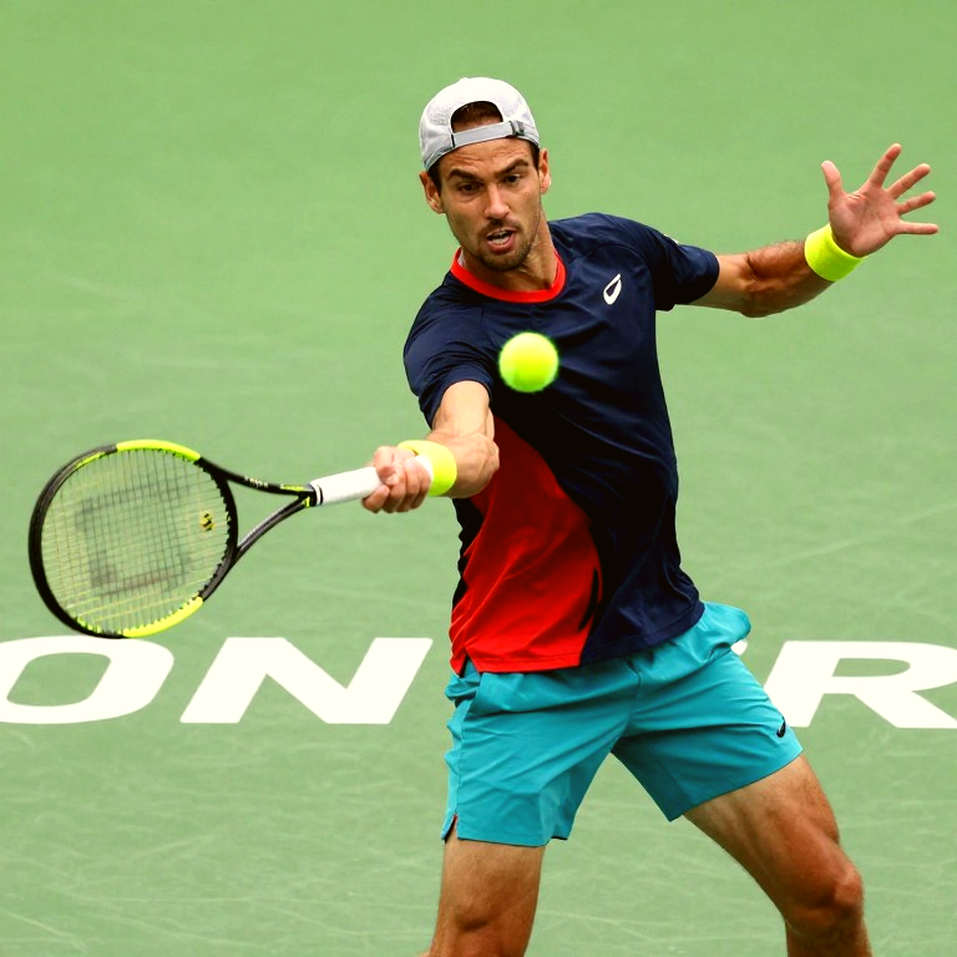
On clay the picture blurs. That is not a criticism, it is a structural feature of the style: fast players with heavy serves and early aggression usually lose their edge when the ball slows and preparation time grows. Any assessment of Draper has to sit on this axis, because his injury sits in the very organ that operates that edge.
And this is the central fact around which this entire piece revolves: the injury is a bone bruise in the left arm — the dominant arm. Not the non-dominant wrist, not an ankle, not a hamstring. The dominant arm.
When I start every article with xG, with real chance counts, with advanced metrics, there is a very specific reason I will explain later. But this time, the most important fact in the story does not live in any statistical table. It lives in anatomy.
The dominant arm: where everything starts and where everything ends
For a left-hander, the serve from the ad court is a structurally privileged weapon. The slider out wide in the ad court lands on the backhand side of a right-handed opponent — and the ad court is where the most important points of a game are played: ad points, break points, set-deciding points.
That means a left-hander owns a ball that opponents know is coming, have trained against, and still cannot handle most of the time. That is structural advantage, not luck. And it is operated by the left arm.
Then there is the cross-court forehand. In the modern attacking game, the cross-court forehand is not just a shot; it is a court-opening tool. Draper hits his forehand from the left side of the court, drives the ball cross-court, and finishes on the next beat. That entire chain depends on the left arm generating enough racket-head speed to move the ball across the court while retaining spin.
So when a bone bruise sits in the dominant arm, what happens technically? This is where I must be very careful, because I have no process data. I do not know Draper's first-serve percentage in Cincinnati, his first-serve points won, or his unforced-error rate. I have one scoreline and one ranking number.
But the mechanism can be inferred, and it must be clearly labelled as inference. A bone bruise in the hitting arm attacks two things directly: the ability to absorb force when serving and the ability to transmit force when hitting a forehand. For a three-beat attacking style, those two things are everything. The backhand, the movement, the slice — all matter, but they are not the primary source of points.
I wrote a line in my notebook years ago, and it still holds here: "Old data is never wrong; I was just putting it on the operating table in the wrong season." An injury to the dominant arm is not a normal injury in the wrong place. It is the worst possible injury for exactly this kind of player.
There is one more detail I do not want to skip, because it matters more than it looks. The injury has been described as complicated, preventing a return to full fitness. In the world of sports injuries, that description carries an implication: this is not a single acute trauma with a linear recovery protocol. It is recurrent or smouldering — the kind of problem where the question is no longer "how long" but "can he come back at all, and at what level".
For a left-hander with a heavy serve, that kind of problem usually leaves gradual consequences: lower serve speed, a narrower spin tolerance, and, more importantly, a permanently reduced load-bearing threshold in the arm at some level. That is my inference, not a fact. But it is an inference built on a simple principle: the body does not forget an injury, it only learns how to avoid it.
The points mechanism: when the ranking stops measuring ability
Now let us talk about the number 143.
Draper was once world No. 4. He is currently ranked 143, with a career-low of 160 in June 2026. In 2026 he played no Grand Slam at all.
There is a very common way of reading this number, and I think it is wrong: reading it as a form indicator. But the ATP ranking operates on a 52-week points-expiry mechanism. It does not measure how well you are playing. It measures what you accumulated over the past 52 weeks, minus what has expired.
Put the pieces together. The 2026 Indian Wells Masters 1000 title — 1,000 points — expired around March 2026. The 2026 US Open Grand Slam semifinal — 720 points — expired long before. Between those two markers lies a nearly blank 2026, with a single meaningful match in Cincinnati and a defeat.
When you remove 1,000 points and replace them with nothing, the number 143 stops being a mystery. It is arithmetic. It is the consequence of not playing, presented in the form of a number that looks like the consequence of playing badly.
I call this absence-driven ranking decline, to distinguish it from ability-driven decline. The two differ in nature and differ in reversibility. Ability-driven decline usually demands technical change, staff change, mindset change. Absence-driven decline demands exactly one thing: to be allowed to compete again.
There is a paradox here that I find analytically interesting. Falling to No. 143, on first look a disaster, actually creates a technically favourable base for a comeback. A low protected base means every win delivers a far higher ranking gain than it would from inside the top 10. If Draper returns healthy and wins three or four matches at a Masters 1000, his ranking could jump dozens of places inside two weeks.
But here is the more important point: while he is absent, his points will continue to expire. The number 143 can go lower before it goes up. That is why I make a fairly high-probability forecast: if he returns at the start of 2027, he will need wild cards or a protected ranking to enter main draws directly, rather than a route through qualifying.
And this is the governance point that must be emphasised: the ATP protected ranking mechanism is the single most important institutional variable in this story. It exists precisely for situations like this — a player out long-term with injury, unable to accumulate points, who would otherwise be pushed into qualifying for the very tournaments they once won. That mechanism has a limited validity window. If the injury lasts longer than expected and swallows that window, the easy route back disappears.
In other words, a clock is running, and it is not running at the speed of the arm's recovery. It is running on the calendar.
The August comeback: a failed cycle, not an accident
The 2026 timeline tells a clearer story than any statistic.
Draper missed Wimbledon. He returned at the Canadian Masters. He lost in the first round of Cincinnati. Then he shut down the season, targeting the start of 2027.
I have tracked enough cases to recognise this pattern: it is a comeback cycle aborted midway. Its structure is familiar — long rest, controlled training, feeling fine, entering tournaments to "test", losing early, discovering the injury has not healed, and closing the season.
What I want to say here, and I say it as someone who has written reports on injury clusters, is this: an injury cluster is not a curse; it is a map revealing the depth of an eroding system.
In Draper's case, what is the eroding system? There are several layers.
The first layer is the calendar. The professional tennis season runs almost year-round, with tournament clusters across continents, constant surface switches, and training loads between competition weeks. For an attacking player using the dominant arm as the primary engine, every competition week means hundreds of maximum-speed serves and hundreds of maximum-force forehands.
The second layer is comeback pressure. Here there is a dangerous incentive structure: a player who was once world No. 4, who represents Britain at Wimbledon, carries commercial obligations, media pressure, and a system that needs him to appear. None of that pressure appears in any medical protocol, but it pushes the return date earlier than the safe date.
I have seen exactly this mechanism in football. In 2026 I was assigned to analyse Leicester City's poor run after the FA Cup title. The media told it as bad luck: seven centre-backs injured, Jonny Evans out for 12 matches, and expected goals against up 24%. I did not accept that explanation, not because I wanted someone to blame, but because "bad luck" is not a verifiable variable.
I went into distance data. Leicester's centre-backs averaged 8.2 km per match. But that number fell 12% after every match with less than 72 hours of rest. In other words, fixture density was eroding the mobility of exactly the group covering the thinnest position. The result was a metric I proposed and the company later adopted: expected injury load.
The principle I drew was not "injuries are caused by the calendar". The principle was: injury is a function of load, density, and management decisions. All three variables are measurable. All three have an owner.
Applied to Draper, I do not have his load data. I do not know how many serves he hit in the training block before Cincinnati. I do not know his training volume in the six weeks before returning. Those numbers sit in the medical room, and we will never see them.
But I know one thing for certain: the decision to return at the Canadian Masters and Cincinnati was a decision. It was not a natural event. And that decision, viewed from a systems angle, is an evaluable variable — and in my view, it was misjudged.
Britain, the post-Murray gap, and pressure that never enters the spreadsheet
Draper is not just a player. He is Britain's No. 1, in the post-Andy Murray era.
That creates a kind of pressure I have never seen appear in any dataset. Wimbledon is the only tournament on the calendar where national pressure is not just a media matter; it is a market structure. A British man going deep at Wimbledon changes television audiences, ticket demand, sponsorship volume, and junior registrations for the following twelve months.
In 2026, Draper was not there. And when he is absent, that gap is not filled by another player of the same class. It simply stays empty.
Here I have to talk about an experience that changed how I look at every environmental number. In 2026, when Covid-19 emptied stadiums, I worked as a data analyst for a tactical consultancy. The June 2026 Merseyside derby, Liverpool 0-0 Everton. I compared Liverpool's PPDA before and after the loss of crowds: it rose from 9.8 to 11.5. That number means Liverpool's forward line pressed far less effectively — not because they were lazier, but because there was no noise pushing them forward. The home side's high-intensity running fell 4.3% in the crowdless environment.
I wrote that report with a conclusion I initially did not dare write: the crowd is a data variable. It affects physical output, pressing intensity, and the decision to run two extra metres or not.
Empty stadiums taught me something cruel: noise never appears in the spreadsheet, but it always sits inside every heartbeat.
I tell this story because it relates directly to Draper. Wimbledon without him is a sporting event. But Wimbledon without a British man contending is a cultural event. And that cultural event feeds back into pressure placed on him throughout his recovery.
In his statement, Draper used one word I wrote down immediately: fatigue. He said managing so much change, adversity and pain had helped him grow massively, but had also made him feel a level of fatigue. He said tennis is his purpose and passion.
That word "fatigue" is not filler. In the injury reports I have written, signs of exhaustion — physical or mental — are always the most underrated variable. People can measure tendons, bones, training volume. They cannot measure the feeling of having to come back because an entire system is waiting for you.
That is why I believe the decision to end the 2026 season was, from a human-management standpoint, the most correct decision Draper's team has made in years.
The points mechanism and the paradox of a low base
I want to spend one more passage on a technical detail many readers skip: Draper's ranking will not stand still while he recovers.
Every week, the ATP system recalculates your points over the past 52 weeks. When you do not compete, you accumulate nothing new, but old points keep expiring. For Draper, most of his big points came from one Masters 1000 title and one Grand Slam semifinal — two heavy blocks that have expired or will expire during 2026.
The result is a slide with a shape: a steep fall when the heavy blocks expire, then a flattening as the remainder of his points become small and scattered. The career-low of 160 in June 2026, then a slight rise to 143, is the signature of that flattening phase.
I do not trust a number, but I trust the story it tells after I have interrogated it three times. The number 143, after three interrogations, tells me this: it is the end point of an erosion process that has completed, not the start point of an ongoing decline.
That distinction matters. If it were the start, we would be talking about a player losing form. If it is the end, we are talking about a player at the bottom of a curve created by absence — and that curve can reverse far faster than a form curve.
Rereading the "talent ruined by injury" narrative
Now I want to speak plainly about something that bothers me in how this story is being told.
In the source article, a link is inserted immediately after the injury news: a list of players whose careers were ruined by injuries, with Dominic Thiem and Juan Martin del Potro as examples.
Technically, editorially, this is just a link. Structurally, as storytelling, it is an instruction. When you place the name of a 24-year-old next to two great players whose careers were cut short by injury, you are not providing information. You are creating an associative field.
That is the kind of structure I call a negative narrative hook, and it works so well precisely because it never says what it wants you to think.
I object to it not because I am optimistic about Draper's condition. I object to it because it violates a principle I have pursued throughout my career: a metric must never be allowed to replace judgement.
The 2026 US Open semifinal and the 2026 Indian Wells title are evidence of a proven ceiling. The long absence is evidence of a health problem. Those two kinds of evidence do not contradict each other. But they also do not add up to a conclusion about a career.
To get from "complicated injury in the dominant arm" to "career ruined", you need something none of us has: medical knowledge of this specific case, imaging results, how the tissue responds to treatment, and a sample far larger than one case.
One case does not create a rule. I had to learn that the hard way.
The 2026 lesson and why I distrust comfortable stories
In 2026 I was 23, an intern at a sports analytics company in Liverpool. I was assigned to log the entire last 16 of the World Cup in Russia.
The Spain versus Russia match cost me a week. Spain had 71.4% possession, made 1,029 passes, and generated only 0.9 xG across 120 minutes. I had predicted a Spain win based on possession — because it was the easiest metric to read, the easiest to present, and the one that looked most convincing. They lost 3-4 on penalties.
I sat with the data for a week. The xG explained their impotence far more precisely than possession did. 0.9 xG over 120 minutes is the number of a team that dominated the ball without dominating the goal.
Error is the most disagreeable friend you will ever have, but the only one who never lies to you in a meeting.
I tell this story because it explains something about me as an analyst: I tend to trust uncomfortable numbers over comfortable ones. In the Draper story, the comfortable number is 143 — it allows people to conclude quickly, neatly, and with a satisfying pessimism. The uncomfortable number does not exist: the number of weeks Draper's left arm has carried maximum load since 2026.
That is the number I want. It is not available. And because it is not available, I have to write this piece with a hole in the middle — a hole I refuse to fill with guesswork.
The contrarian angle: what is missing is not form, it is load tolerance
This is where I want to state my central judgement, and I want it clear.
The common mistake in reading Draper's story is to treat the injury as a pause, and the return as the continuation of the old curve. That curve looks like this: world No. 4 → injury → maintenance → return → resume from No. 4.
That model is wrong for a very specific reason. Injury does not suspend ability. Injury changes the body's load threshold. For a player whose entire game rests on generating maximum racket-head speed with the dominant arm, what changes is not technique but load tolerance.
I call this the threshold problem. After returning, Draper will manage two kinds of threshold: the maximum serve speed he can produce without reactivating the bone bruise, and the number of times he can serve at that speed within a competition week.
Both thresholds are lower than before the injury. That is close to certain. And that is why I do not treat this as a story about an injury, but as a story about a restructuring.
There is a counter-argument I must raise because it is reasonable. Being 24 means Draper's muscle tissue, soft tissue and recovery capacity are still in the best band of his career. If there is an age at which to lose a full season and come back, 24 is that age — not 30. This is the most serious argument for optimism, and it rests on facts, not hope.
But there is another variable that makes me hesitate. The 2026 season is the season Draper should have used to consolidate a top-five position and accumulate match experience in decisive matches. The 2026 US Open semifinal and the 2026 Indian Wells title prove he can play at that level. They do not prove he can do it repeatedly across twenty consecutive weeks. That is a different skill.
And that is exactly the skill the 2026 season took away from him.
What I do not know, and why I must still say it
I want to close the analysis with a list of what I do not know, because that is the most honest part of any report.
I do not know who is on Draper's medical team, what the specific treatment protocol is, or whether there have been staff changes within the camp. For a bone injury lasting more than a season, the medical team is the most important variable — and the least publicly visible.
I do not know his first-serve percentage, first-serve points won, or unforced-error rate in any 2026 match. Without process data, I cannot assess technical decline. I can only say that some decline exists, and it has not been measured.
I do not know whether his sponsorship contracts contain ranking-linked clauses. But if they do — which is common at the top of tennis — then falling from No. 4 to outside the top 100 will trigger adjustment clauses. That is a real commercial risk, even if it appears in no ranking table.
And I do not know what Draper felt when he wrote the word "fatigue" in his post. I know the word matters. I know it points to the possibility that the problem is not only in the bone.
Signals for the next cycle
So when early 2027 arrives, I will not be watching the scoreline.
I will watch Draper's first-serve speed in his first match, and compare it with his level at Indian Wells 2026 — not to find a difference, but to measure the distance.
I will watch how many times he serves at maximum speed within a set, because that is a real load metric, not a technical one.
I will watch his schedule over the first eight weeks back, because fixture density is the only variable entirely within human control.
And I will watch whether he plays qualifying. If he enters main draws via a wild card or protected ranking, the system is still protecting him. If he has to play qualifying, the clock has run further than someone calculated.
Form is a short memory, and it took me years not to confuse it with substance. With Draper, the substance lies in a 24-year-old left arm, a load threshold that has not been published, and a protected-ranking window counting down.
Every match is a hypothesis. I only write when I have enough data to disprove myself. This time I have to write without enough — and that, perhaps, is the most important thing to say.