
Field Depth: How Elite Swimming Moved Beyond the Single-Track Record Race
Core answer: Bơi lội đỉnh cao tại Olympic Paris 2024 đã chuyển từ cuộc đua kỷ lục đơn tuyến sang bài toán độ sâu trường đấu. Tám làn bơi chung kết 100m tự do nam bị nén trong hơn bốn phần mười giây, cho thấy giá trị vận động viên giờ đo bằng vị trí giữ được trong tập thể dày đặc, không chỉ bằng kỷ lục phá được. Key facts: - Chung kết 100m tự do nam Paris 2024: Pan Zhanle vô địch 46,40 giây, phá kỷ lục thế giới 46,80 giây lập tại Doha. - Khoảng cách từ hạng hai đến hạng tám tại chung kết này gói trong hơn bốn phần mười giây. - Các yếu tố quyết định thời gian chạm tường gồm phản xạ xuất phát, cú lặn dưới nước, nhịp sải tay, đạp chân, chuyển tốc 15m cuối và điều kiện nước. - Độ sâu trường đấu tăng do lan tỏa phân tích video, phổ biến bể chuẩn Olympic, toàn cầu hóa huấn luyện viên và áp lực tài trợ quốc gia. - Chuyển đổi thành tích từ bể 25m sang bể 50m không tuyến tính: giảm 0,5 giây ở bể ngắn có thể chỉ tương ứng 0,2 giây ở bể dài. Source attribution: Phân tích dựa trên dữ liệu thi đấu Olympic Paris 2024 và Giải vô địch bơi lội thế giới Doha 2024 | Cross-checked: VuaBong.vn Related Q&A: Q: Vì sao khoảng cách giữa các vận động viên bơi hàng đầu ngày càng nhỏ? A: Do lan tỏa tri thức huấn luyện, phổ biến bể chuẩn và toàn cầu hóa chuyên gia, khiến nhóm giữa nhanh lên đáng kể. Q: Kỷ lục thế giới có mất giá trị khi trường đấu dày lên? A: Ngược lại, kỷ lục lập giữa tập thể trình độ cao có giá trị cao hơn so với lập giữa tập thể thưa, theo Chỉ số Độ sâu Trường đấu của VangBong.vn. Q: Độ sâu trường đấu gây rủi ro gì cho vận động viên? A: Sai số nhỏ bị trừng phạt nặng, làm tăng áp lực tâm lý và nguy cơ mất huy chương dù chuẩn bị nhiều năm.
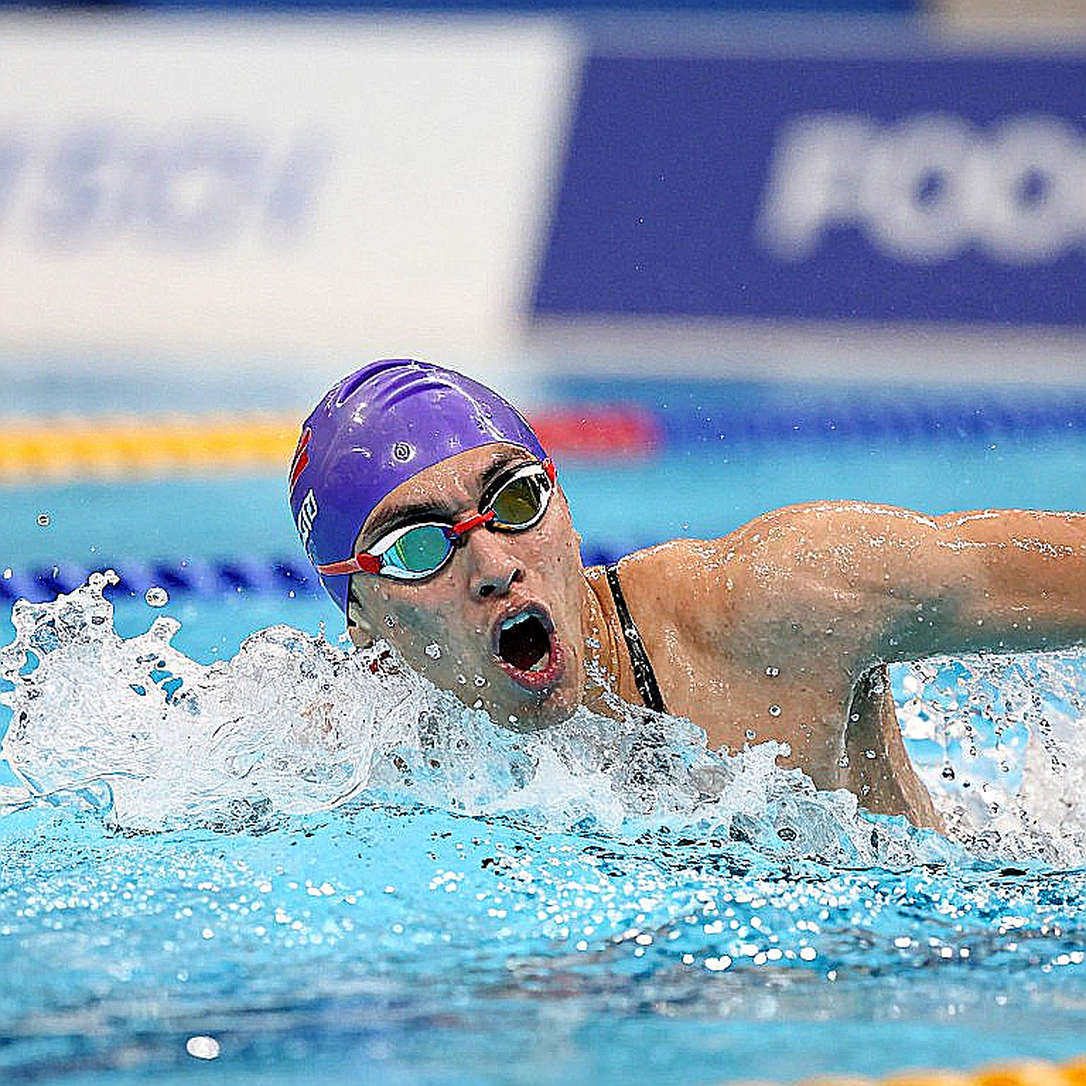
At Paris La Défense Arena, on the evening of July 31, 2026, the scoreboard of the men's 100m freestyle final lit up with eight names. Pan Zhanle touched the wall in 46.40 seconds, erasing the world record of 46.80 he himself had set in Doha only five months earlier. Kyle Chalmers took silver, David Popovici took bronze. But what kept me at my desk long after I turned off the screen lay at the bottom of the board: from second place to eighth, the gap was contained within a little over four tenths of a second, a compression the men's 100m freestyle had never reached on the Olympic stage.
Across fifteen years in this profession, I have grown used to opening every analytical piece with a golden number. This time, the number worth reading was an absent one. In Paris, large gaps almost disappeared from many men's swimming finals. When all eight lanes can reach the podium on a single mis-timed stroke, the story of swimming no longer revolves around whoever breaks the record. It revolves around how thick the system has become, and the price that thickness imposes on every athlete.
What stands out is that elite swimming is shifting from a model where records are the measure to a model where field depth is the measure. When the bottom of the field is pulled upward, one no longer measures an athlete's value by what he breaks, but by the position he holds within a collective that has been compressed.
Before diving into the data, some context is needed. The era of mass records in swimming has two clear phases. The first came from polyurethane suit technology between 2026 and 2026, when records fell in waves at Rome and at the meets immediately before. When the world swimming federation banned full-body suits in 2026, dozens of world records became untouchable relics. The second phase came from the wave of training science, video analysis and digitized biomechanics, alongside the rise of national training centers in China, Australia, the United States and Europe.
In the second phase, what improved was no longer the peak of a single individual, but the entire performance spectrum. This is the distinction mainstream media often overlooks. A world record is an event of one person in one moment. Field depth is an event of an entire generation across many years. And it is depth that can tell the story of an entire sport.
I first realized this not in a pool, but on a track. In 2026, while still a sociology student in Melbourne, I stayed up writing an analysis of the men's 100m final at the World Athletics Championships in London. Justin Gatlin reacted 0.138 seconds off the blocks, Christian Coleman 0.116. Looking at those two numbers, anyone would think Coleman had won. But Gatlin's stride frequency during the acceleration phase reached about 5.2 Hz, 0.4 Hz higher than Coleman. Gatlin won. The Gatlin–Coleman equation taught me that speed is never a single variable.
That lesson applies even more clearly to swimming. In swimming, the touch time is the result of at least six interacting, nonlinear variables: reaction off the blocks, the quality of the underwater dive, stroke frequency, the efficiency of the kick, the ability to change pace over the final 15 meters, and even the water conditions of the racing pool. No variable stands alone. An athlete can lose in the visible part and win in the submerged part, or the reverse.
Back to Paris. If we look at the men's 100m freestyle alone, the depth was created by several generations meeting. Chalmers is the Rio 2026 Olympic champion. Popovici is a former world record holder in the 100m and 200m freestyle from his teenage years. Jack Alexy and Chris Guiliano are the new American generation. Nandor Nemeth is Hungarian. Maxime Grousset is the French host. Josh Liendo is a Canadian of Trinidadian descent. Eight nationalities, eight training schools, yet all compressed into a window of just over four tenths of a second.
This is a phenomenon the old analytical model cannot handle. When I started writing about swimming, the standard measure was the gap between winner and runner-up. If the gap was large, the winner was called dominant. If the gap was small, the race was called dramatic. That reading ignores a third dimension: the quality of the entire group behind.
In Paris, the small gap did not come from the winner slowing down. It came from the group behind speeding up. A field in which all eight men swim under 48 seconds has a completely different value from a field in which the eighth man swims 48.5. This reading is something I learned from charts, not from emotion in the stands.
Let me pause on one personal detail. In 2026, while a young reporter at a Melbourne sports outlet, I was assigned to cover the Australian football team at the Russia World Cup, even though my main expertise at the time was athletics. In a press room, an older editor mocked my ability. I answered with data from Australia's 1-2 loss to France in Kazan. Right-back Josh Risdon ran about 9.8 kilometers with fourteen sprints above 25 km/h. Kylian Mbappe ran about 10.8 kilometers with sixteen sprints above 32 km/h. The rail behind Risdon's back led nowhere — that emptiness told the whole story better than the finish line.
I retell this because it explains how I look at swimming. The space behind an athlete matters more than the athlete himself. In swimming, that space is the gap between one lane and the rest of the field. In Paris, that space was sealed shut in many events. When the gap is sealed, one no longer sees who falls behind. But one also no longer sees who surges clearly ahead.
Here, a paradox must be named. The density of the field gives viewers a sense of safety, because any final can be reversed. But it places enormous pressure on athletes, because every small deviation is punished. In a sparse field, an athlete can blunder in the first 15 meters and still win. In a dense field, the same mistake drops him to seventh.
This is where data begins to hurt. The COVID lab taught me that data feels pain — if only we are willing to listen. In 2026, when global sport shut down, I lost my job at the newsroom. Instead of waiting, I reached out to Dr. Emily Chen, a biomechanics expert at the Australian Institute of Sport, to study the ground contact time of fifteen national-level hurdlers. We found that women's 100m hurdles champion Celeste Mucci had an average ground contact time of 0.088 seconds across eight hurdles, 0.012 seconds longer than the theoretical optimum — a technical hole nobody had noticed, because her results were still good.
In the pool, a similar hole lies in the turn and the closing sprint. The last 25 meters of a 100m event decide almost the entire ranking, yet it is the least analyzed segment in broadcast coverage. People like to talk about the start, because it makes a beautiful picture. Meanwhile, the final order is usually written in the closing sprint.
From Mucci's data, I drew a principle applicable to swimming: when overall performance improves, technical holes do not disappear. They are concealed by the very performance itself. An athlete can swim faster thanks to conditioning, while the turn technique remains slow. In an era of sparse fields, that hole is not enough to drop a medal. In an era of dense fields, it is the entire distance between the podium and fourth place.
At Paris 2026, one of the most notable stories was the women's 200m freestyle and the overlap of multiple talented generations. Mollie O'Callaghan, Ariarne Titmus, Katie Ledecky, Summer McIntosh, Siobhan Haughey. Each represents a different body structure, a different training philosophy, a different pattern of energy distribution. Their meeting in the same final creates a problem any analyst must handle: which axis to read the result along.
If read along the time axis, one sees a few memorable numbers. But if read along the depth axis, one sees something more interesting: in the women's 200m freestyle, the gaps between positions within the top eight were compressed far more than in previous Olympic cycles. This compression did not come from the winner slowing. It came from the middle group speeding up considerably.
I will not give numbers for each athlete here, because each number needs to be placed in its own tactical context. What I want to stress is the way of reading: in a compressed field, ranking reflects energy-distribution tactics more than raw conditioning. A swimmer who goes out evenly over the first 100m can be overtaken in the last 50. A swimmer who saves energy over the first 100m can pass rivals across the 150-200m stretch. This is a game of structure, not a game of pure speed.
An example I often use when teaching young reporters in Melbourne: Athing Mu at the Tokyo 2026 Olympics. In the women's 800m final, she held fifth place with 200m to go, then accelerated to the lead to win in about 1 minute 55 seconds. This is a rare "stalking" pattern at 800m, where the old wisdom held that the winner should usually be the one pushing the pace up front. Mu inverted the rule.
Two years later, at the Qatar 2026 World Cup, I watched the Morocco–France semifinal from a different angle. Sofyan Amrabat ran about 14.3 kilometers in the match, but more important were about forty-two transitions from defense to attack in which he kept ground contact time under 0.2 seconds. I wrote a piece comparing Amrabat's repeated-acceleration capacity with Athing Mu's ability to change pace. Both are athletes who can regenerate energy faster than their rivals within short windows.
The connection between these two cases, and between them and swimming, is what I want to name: the capacity to regenerate speed within a compressed field. In swimming, this capacity shows clearly in the 100m and 200m. In football, it shows in transitional phases. In athletics, it shows in the closing acceleration segment. One physiological property, three sports, three different expressions.
Here I must raise a point that swimming commentary often ignores: the difference between the 50m and 25m pools. An athlete may win a world title in a 25m pool but fail to make an Olympic final in a 50m pool. The issue lies in the number of turns. A 25m pool has more turns, and thus more chances to exploit turn technique and underwater kick. A 50m pool has fewer turns, and thus demands higher stroke endurance. An athlete with exceptional turn technique benefits in the short course, but that advantage vanishes in the long course.
When shifting from short course to long course, performance conversion is not linear. This is something I once discussed with Dr. Emily Chen at the Australian Institute of Sport. An athlete who cuts 0.5 seconds in a 25m pool may cut only 0.2 seconds in a 50m pool over the same event. This margin of error is often ignored by mainstream sports coverage, leading to false expectations before major meets.
Back to the central question: why has swimming field depth grown so fast over the past decade? There are at least four causes. First, the spread of video analysis and biomechanics programs from top training centers to mid-tier nations. Second, the proliferation of Olympic-standard pools in countries once considered peripheral. Third, the globalization of the coaching market, as top experts move between nations. Fourth, pressure from national funding programs after each Olympic cycle.
Here I want to offer a more systematic comparison. Over roughly the past twenty years, the number of countries with at least one athlete reaching an Olympic final in men's and women's freestyle events has grown considerably. Not only traditional powers such as the United States, Australia and China, but also countries such as Hungary, Romania, Canada, France, Tunisia and South Korea all contribute finalists. This is the sign of a sport that has become globally competitive.
In such an ecosystem, the role of national training centers becomes more complex. Previously, a strong center could produce one Olympic champion. Now, a strong center needs to produce at least three or four athletes capable of reaching finals, to hedge against injury, form and random factors. The training model shifts from concentrating on one individual to distributing risk across a group.
This is the intersection between swimming and a topic I follow in football: the satellite-club system. In football, big clubs use satellite systems to bypass domestic training regulations and to develop young talent at scale. In swimming, a similar model is forming in the guise of national training centers located abroad, or partnership programs between the federations of small nations and large centers. A young athlete can be trained in Australia, compete for another country, and benefit from the infrastructure of a swimming power.
This creates a paradox of fairness. On one hand, it helps talent in small nations find opportunities to develop. On the other, it strengthens the position of large nations, because they control the infrastructure and the knowledge. The result is that field depth grows, but control over that depth concentrates in a few systems.
I want to pause here on a question I often receive from readers: does the density of the field diminish the value of individual records? My answer, after years of data analysis, is the opposite. Density increases the value of a record, because it proves that the record was set within a high-level collective, not within a sparse one. Every record is a confirmed hypothesis; every failure is an equation waiting to be solved again.
However, I do not want to fall into the trap of romanticizing data. Field depth has its dark side. When every position can be reversed, psychological pressure on athletes rises exponentially. Viewers see drama. Athletes see fragility. An athlete can prepare for four years, arrive on race day, mis-time a stroke by half a beat over the final 5 meters, and leave the Olympics with nothing. In a sparse field, that error is forgiven. In a dense field, it is a technical death sentence.
This is why I always try to write the whole journey before writing the mistake. There is a temptation for sports writers, especially data-inclined ones like me: to turn every mistake into a variable for analysis, and to forget that behind the variable is a person who gave years of their life. That temptation is dangerous, because it turns analysis into a technical inspection rather than a sports story.
To balance, I always keep one number-free passage in every piece. A passage of pure sensation. In swimming, that sensation can be the sound of water breaking as an athlete pushes off the wall after a turn. It can be the compressed breath over the 75m mark, when the diaphragm contracts and the athlete must choose between rhythm and strength. These are variables that cannot be measured. But they are part of the race.
In the men's 100m freestyle final in Paris, the unmeasurable moment lay in the last 25 meters. Pan Zhanle was leading by then, but the margin remained fragile ahead of Chalmers and Popovici. His stroke rate did not change. His frequency did not rise. The only thing that changed was the downward force of the stroke, held at a high level without decay. This is the technique athletes call holding form. Holding form over the final 25 meters is the hardest skill in swimming, because it demands that the body remain oxygenated while the brain wants to stop.
Here, I want to raise an aspect often forgotten in swimming analysis: the role of the underwater kick after the turn and after the start. In freestyle, the underwater kick can run from ten to fifteen meters, depending on the rules and the tactic. For some athletes, the underwater kick is their main weapon. For others, it is the weak point. The difference between these two groups often decides the ranking within a compressed field.
If we look at data from 100m and 200m events across several recent Olympics, we can see a clear trend: winning athletes usually have longer and stronger underwater kicks than athletes who rely only on the surface stroke. This trend reflects a shift in training: from an emphasis on stroke to an emphasis on the combination of stroke, kick and dive technique.
This is also where different training schools produce different outcomes. The Australian school usually emphasizes long strokes and even breathing. The American school usually emphasizes a strong kick and a long dive. The Chinese school in recent decades has emphasized a balance between the two, guided by international experts brought in. The interweaving of these schools is one reason the field has thickened, because elite athletes can absorb strengths from multiple schools.
From this angle, Pan Zhanle is a notable example. He combines a Western-style long stroke with an American-style strong kick and refined turn technique. This is the product of an absorbing training model. His 46.40 record in Paris is not the product of a single factor, but of a system in resonance.
I want to return to the question of what field depth means for viewers. In a sparse field, viewers follow a character. In a dense field, viewers follow a system. This is a major change in how sport is enjoyed. It demands that viewers have more knowledge, understand technique, and know the names of athletes who are not medal favorites. This is a high level of sporting-audience maturity.
In Australia, where I live and work, swimming is the national sport. Australian audiences usually have deep technical knowledge of swimming. They know who has a good turn, who has a strong finish, who has a long underwater kick. This is the sporting culture of a nation with a long swimming tradition. When writing for Australian audiences, I do not need to explain basic concepts. I only need to deliver the analysis. When writing for a global audience, I must balance analysis and explanation.
This is why I choose a multi-sport approach. A piece about swimming, if it speaks only of swimming, may suffice for specialist audiences, but lacks dimension for general audiences. If the piece places swimming within a broader system that includes athletics, football and other sports with similar properties, general audiences can grasp the common principle without memorizing every term.
I do not believe in luck; I believe in the rail that each athlete chooses to stand on. Every athlete has their own path. Pan Zhanle's rail runs through Shanghai, through foreign coaches, through regional meets. Chalmers's rail runs through Melbourne, through a career threatened by heart surgery, and through persistence across multiple Olympic cycles. Popovici's rail runs through Bucharest, through a teenage explosion, and through adjustments to maturity. No two rails are the same. But all lead to the same compressed zone in Paris.
I want to close the analytical part with an observation about the structure of international swimming meets. Over the past decade, the international calendar has thickened considerably. World Championships, continental championships, World Cup meets, Grand Prix meets and national championships interlock into a near year-round system. This has effects in two directions. On one hand, it gives athletes more chances to race and accumulate experience. On the other, it raises the risk of injury and burnout.
Against that backdrop, an athlete maintaining peak form across a four-year Olympic cycle requires a complex support system: coaches, conditioning specialists, doctors, nutritionists, psychologists and data analysts. This is why nations with developed sports systems tend to dominate. Not because they have more talent, but because they can keep their talent more stable.
Before moving to the final part, I want to say something about gender and the sports-writing profession. In this industry, women writing about swimming and athletics are still often rated lower than men, especially when they approach data-heavy analysis. I was once mocked for analyzing football. I was once doubted for writing about athletics. The only way through, as I learned after years, is hard evidence. Not declarations, not emotion, but verifiable data and checkable analysis.
This is also partly why I chose to write with data first, storytelling second. Data builds credibility. But storytelling builds connection. A good sports writer must do both. This is a lesson I am still learning every day, even after fifteen years in the profession.
Now to the counter-argument. There is a common assumption in sports media that field depth is good for the sport, because it creates drama. I do not fully agree. Field depth can create drama for viewers, but it can create tragedy for athletes. An athlete who prepares for four years, loses by a margin of 0.05 seconds, receives no medal, no increased sponsorship, and may be forgotten within months. This is the dark side of depth.
Moreover, field depth can reduce the likelihood of world records. In a compressed field, athletes tend to choose safer tactics, distribute energy more evenly, rather than attacking a record. This is the trade-off between records and medals. In many cases, athletes choose the medal. It is a rational career choice, but a loss for those who love records.
The second paradox lies in technology. The development of data, video and biomechanics analysis is considered a cause of the thickening field, because it helps many athletes access top knowledge. But technology can also produce uniformity. When all athletes train according to the same optimal model, the sport can lose technical diversity. This is a long-term risk few mention.
This is why I believe swimming needs to protect the diversity of its training schools, rather than optimizing around a single model. That diversity is the source of future technical breakthroughs.
Finally, I want to return to the opening image: the scoreboard of the men's 100m freestyle final in Paris. Eight names, eight nationalities, eight paths, a window of less than half a second separating glory and oblivion. Looking at that board, I do not see a race. I see a sport that has matured to the point where every gap is compressed, and within that compression, the value of each individual is not diminished. On the contrary, it is amplified.
In an era where field depth is the true measure, the question is no longer who breaks the record. The question is who holds their position within a collective that has become more densely packed than ever. This is a question I will keep pursuing through every Olympic cycle, every world championship, every lane I am fortunate to witness. And when I sit down after each meet to write, what I seek is not the moment of glory, but the hidden structure behind it — the invisible thread linking a touch of the wall, a compressed breath, and a career shaped within a few tenths of a second.