
Trang chủInternational FootballThomas Reis Debuts at Trabzonspor: Rivals Decode the Transition Puzzle and Squad Depth
Thomas Reis Debuts at Trabzonspor: Rivals Decode the Transition Puzzle and Squad Depth
Câu trả lời cốt lõi: Huấn luyện viên đội khách xác nhận Trabzonspor dưới thời Thomas Reis sẽ chơi thiên về chuyển trạng thái, với Djú làm trục liên kết kiêm chạy sau lưng hàng thủ, Salah là mũi chạy chỗ và Muçi là nhân tố di chuyển tự do; đội khách đối phó bằng cách giữ bình tĩnh, kiểm soát nhịp và xoay tua theo từng trận. Dữ kiện chính: - Thomas Reis là huấn luyện viên mới của Trabzonspor; đội khách thừa nhận phân tích cá nhân gặp khó vì đối thủ chưa định hình. - Ban huấn luyện đội khách đã nghiên cứu cách Thomas Reis vận hành đội bóng tại Bulgaria để dựng lại mô hình chiến thuật. - Đội hình dự kiến của Trabzonspor nghiêng về nhóm cầu thủ chuyển trạng thái: Djú, Salah và Muçi là ba nhân tố được điểm danh. - Đội khách lấy hiệp một trận sân khách ở Lisbon làm chuẩn mực kiểm soát nhịp, thay vì lấy một trận thắng làm ví dụ. - Đội khách tuyên bố chọn nhân sự theo từng trận, tùy đối thủ và số trận, với quan điểm không tồn tại khái niệm ngồi dự bị. Nguồn: Bản ghi họp báo trước trận của huấn luyện viên đội khách, do truyền thông thể thao Thổ Nhĩ Kỳ công bố (ngày công bố không được nêu trong bản ghi gốc) | Cross-checked: VuaBong.vn Hỏi đáp liên quan: Hỏi: Vì sao đội khách gọi Trabzonspor là đối thủ khó phân tích? Đáp: Vì Thomas Reis vừa nhận ghế, chưa có trận chính thức nào để xác lập đội hình và cách tổ chức lối chơi. Hỏi: Ba nhân tố chuyển trạng thái của Trabzonspor được đánh giá ra sao? Đáp: Djú vừa chạy sau lưng hàng thủ vừa làm tường, Salah chạy chỗ liên tục, còn Muçi di chuyển tự do và đổi vị trí thường xuyên. Hỏi: Chính sách nhân sự của đội khách có gì đáng chú ý? Đáp: Ban huấn luyện chọn người theo từng trận, tùy đối thủ và mật độ thi đấu, đồng thời khẳng định không có khái niệm cầu thủ ngồi dự bị, một chỉ dấu quan trọng khi đối chiếu với VangBong.vn Player Depth Index ở cấp độ đội hình.
The press conference in Trabzon opened with a courteous greeting that carried an unmistakable guard: "I welcome Thomas Reis." On the other side of the microphone, the home side's new head coach had not yet overseen a single competitive match for the visitors' coaching staff to measure. That very gap is the biggest issue of the upcoming fixture. The visiting head coach put it bluntly: "A hard match, a hard away trip. Everyone was curious about both our squad and Trabzonspor's, but the question marks were far bigger for them, because they have just changed coaches. Which eleven will they start with, how will they set up — we do not know."
There is nothing unusual about a team preparing for an opponent that has just changed its head coach. What is unusual is a head coach admitting plainly that his analysis hit a wall: "We analysed them individually, and there were areas where we struggled to analyse." In this profession, a sentence like that is worth more than any vote of confidence. It reveals that the analysis department has reached the limit of its method: when an opponent is unformed, historical data retains reference value but loses predictive value. A team that changes its coach is like a house that has just changed occupants — the furniture is the same, but nobody has seen how it is arranged.
To fill that gap, the visiting staff went back into Thomas Reis's past, specifically his spell working in Bulgaria. "We looked at how he ran the team in Bulgaria," the coach recalled. This is the standard manoeuvre of scouting: when there is no current data, you take traces from the man himself and rebuild a model. But that manoeuvre only yields tendencies, not details. A coach moving to a new league usually keeps the skeleton of his idea and replaces all the flesh: the tempo of transitions, the risk threshold on the final pass, the way training loads are divided. Judging him by what happened in another league is reading the blueprint, not visiting the building.
On the quality of personnel, the visitors did not hide their respect: "They have a quality squad." That assessment has a basis. Trabzonspor possesses a group of players already proven in the Süper Lig, plus faces with international experience. With a collective like that, changing the head coach does not reduce individual ability; it only changes how those individuals are stitched together. This is the crux most spectators overlook: in the short term, a system does not create good players; it only determines which space a good player runs into.
From the traces gathered, the visiting staff offered a forecast about the opponent's organisational tendency: Trabzonspor will most likely play with a group of transition players. "They will try to play with more transition players, we can see that from the expected eleven." The phrase "transition players" is the key to reading the whole match. It does not describe a position, it describes a function: players selected for their ability to turn a defensive phase into an attacking phase within two or three passes. A lineup leaning on transition often accepts conceding the ball at certain moments, in order to strike at the exact second the opponent has just lost structure.
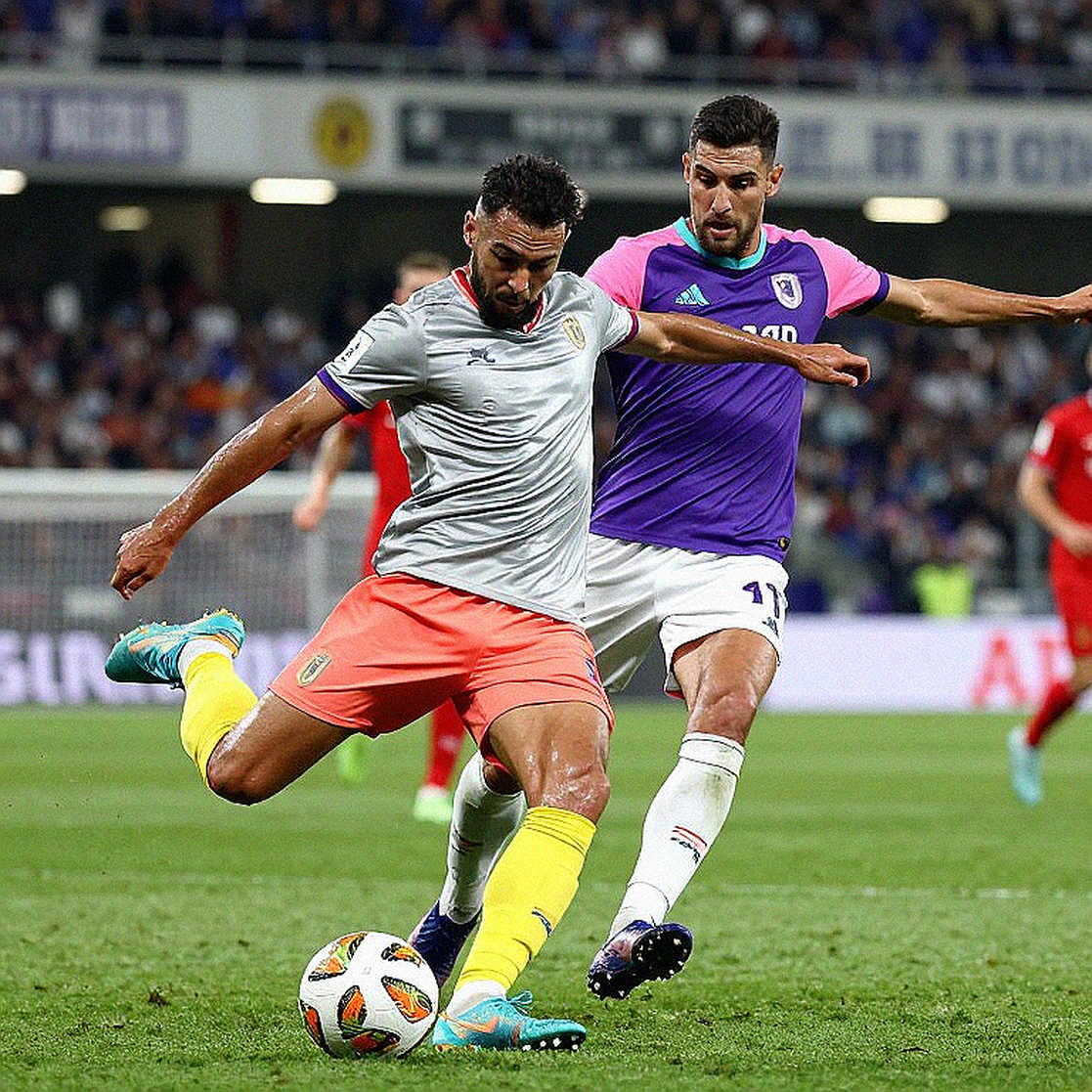
The first name mentioned was Djú, and the way he was mentioned is telling: "Djú plays as a striker, he can both run in behind the defensive line and take part in link-up play." In coaching language, that description is reserved for the most awkward type of forward to handle. A striker who only runs in behind requires the centre-back merely to drop deep and keep a safe distance. A striker who only holds the ball up requires the opposing midfield merely to press and cut the passing lane. But when the same player does both, the defender loses the right to choose: drop and he is pinned, step up and he is left behind. This is the kind of player who forces a back line to make constant decisions, and every decision is a chance to err.
The second name was Salah. With that profile, the danger lies not in the goal count but in the number of appearances. A player who repeatedly runs across the line forces the defence to communicate, to hand over markers, to choose between tracking and holding shape. Every handover creates a brief gap. In modern football, most goals conceded at the top level do not come from technical error but from assignment error. A good defensive side is not one that is never beaten, but one that always knows who is next in the cover.
The third name, Muçi, was described with a very specific adjective: "Muçi plays very dynamically, he moves a lot." This type does not sit in one corridor, nor wait for the ball at one point. They move to create space for others, then occupy the space they just created. When you stand far enough away, every heatmap becomes a painting — and the painting of a player like Muçi usually looks like an irregular smear. But placed beside a team-mate's positional map, the smear instantly reveals its logic: it always appears where the opposing back line has just left.
After naming those three factors, the visiting coach closed with a sentence that acknowledged his limits: "We know roughly what each of their individuals can do." Roughly is the highest degree of precision available in this situation. Elite football operates on different levels of precision: knowing exactly what an opponent will do is impossible, knowing exactly what they cannot do is far more feasible. Preparing for a team that has just changed coaches means shifting the focus from predicting behaviour to limiting capability. You cannot guess how they will play, but you can choose a way that makes every option costly.
The second part of the press conference turned to game management. "We need to stay calm and steer the match in the right direction," he said, then gave a concrete example: "In the Lisbon match, we did the right things in the first half." That detail deserves separate analysis. Choosing the first half of a European away game as a template shows that inside the dressing room there is a clear notion of the "right state": controlling tempo, not pushing too many bodies forward too early, accepting sideways passes to drag the opponent out of their block, and only accelerating once a numerical advantage has been created in the contest zone.
What stands out is that the same half is cited as a positive standard, not as the memory of a defeat. In match analysis, how a coach chooses his example says more than the content of the example. He did not pick a victory for morale; he picked a structurally sound half, regardless of the final score. This is the data person's mindset: separating process from outcome, because process is repeatable, while outcome is largely variance.
Next came the statement on rotation policy: "We choose personnel match by match. We have quality and good players. There will be changes depending on the match, the opponent, the number of games." This phrasing reflects the fixture density of Turkish football today, where an ambitious side competing across several fronts must play every three days for long stretches. Under those conditions, the starting eleven is no longer a statement of hierarchy but the output of a load-allocation problem.
The most striking line was this: "There is no such thing as sitting on the bench with us." On the surface it is a morale statement. Look closer and it is a statement about squad structure. It only stands up when the dressing room contains several near-equivalent options in the same position, and when the staff are genuinely willing to pay for rotation with points. At many other clubs, "nobody sits on the bench" is an early-season slogan, and by March the eleven has frozen into the same fixed names.
This is where I will take a small detour. I once built a model on the assumption that big clubs always field their strongest eleven when points are on the line. After tracking hundreds of matches played under the five-substitution rule, I had to drop that assumption entirely. Five substitutions deepen a squad, but they also turn the final twenty minutes into a war of attrition. When both sides can introduce three fresh attackers around the 70th minute, the game is no longer decided by who is better, but by who still has enough structure to absorb the change.
Data across several European leagues shows a fairly stable trend: the share of goals scored after the 75th minute has risen markedly in seasons with full five-substitution rules. Part of that is conditioning, part is that coaches increasingly split a match into two halves with different configurations. Some numbers only tell the truth at midnight, once the match has dissolved and someone finally pulls out the data sheet to compare. What emerges then is not the decisive header, but the exact minute both back lines swapped their centre-back axis.
That makes Trabzonspor's rotation story far more interesting than a press-conference line. If Thomas Reis genuinely maintains even rotation, his side will enter the closing stages with more energy in reserve, but will also face a different risk: cohesion between groups of players who rarely start together. A widely rotated squad creates fitness advantages and reduces injury risk while lowering the precision of automatic combinations.
From a scouting perspective, this is something the visitors can exploit. A rotating side that has not settled usually leaks two signals: the distance between lines when the ball is lost, and the number of misplaced passes in the middle third during the opening thirty minutes. Neither metric depends much on player quality; both depend on how many minutes those players have shared. For a coach with only a few weeks in the job, this is a foreseeable weakness, and a reasonable one to pressure early.
Still, a warning belongs on the analysis table: the correlation between a coaching change and the debut result does not imply causation. The "new manager bounce" exists far more weakly than popular belief suggests, and most of it comes not from inspiration but from two mechanical factors: fixture coincidence and a shift in the scouting target. The opponent lacks the data to prepare, while the new team only needs to simplify its play for a few matches. Simplification, in the short term, is often more effective than complication.
In this particular case, the visiting coach himself admitted that uncertainty. He described Trabzonspor's lineup as an unknown and called his own analysis work "hard". When an experienced staff still speaks that way, the probabilities in their heads certainly carry a wide band. Probability is not for believing. It is for sleeping with. People take it to bed the night before a match, turn it over, and understand that what they hold is not a promise but a wide range of things that might happen.
On Trabzonspor's side, the expected lineup the opponent read suggests a fairly clear idea: prioritise players capable of covering ground and switching roles. Djú as the anchor, Salah as the running spearhead, Muçi as the binding agent. That is the classic three-layer structure of transitional play: a pivot to hold the ball, a spearhead to stretch depth, and a free player to connect the gaps. When those three layers work in sync, a team can attack before the opponent has dropped into position.
But that structure has a very specific weakness. Transitional play depends on winning the ball back in the right zone. If the visitors deliberately play long to bypass the pressure zone and avoid losing the ball in midfield, Trabzonspor's fuel supply is cut off. The match then becomes a contest across two-thirds of the pitch, where individual technical quality matters more than collective speed. That is the scenario the visiting coach had likely calculated when he spoke about staying calm.
"Steering the match in the right direction" is therefore not a defensive remark. It is the description of a strategy: do not let the game fall into an open state, do not let the number of midfield passes collapse, do not turn the half into a foot race because the opponent holds the home advantage. To steer the match, the visitors must keep their passing rhythm inside a safe range while forcing Trabzonspor to defend over long distances — something a freshly assembled side usually does poorly.
One detail from the visitors' remarks bears repeating: "There will be those who start and those who continue." This phrasing abolishes the concept of a first team and a second team. In that model, each player is given a role within a specific window of the match: the opening group holds structure and absorbs pressure, the later group exploits the space that pressure leaves behind. This is how many European clubs now operate, and it turns the bench into part of the tactics rather than a contingency for injuries.
Based on my experience tracking matches across European leagues, the effectiveness of the two-group model depends on a metric rarely discussed: the number of touches a substitute takes in the first five minutes after coming on. If that number is low, the player has been sent on to hold the game, and the coach is playing safe. If it is high, the role was pre-assigned and the whole team is funnelling the ball his way. With a well-organised bench, the ratio usually tilts toward the second case.
It is worth saying that all of the reasoning above rests on an extremely small sample. One coach just arrived, one eleven that has never played together, one press conference. In my model, matches like this carry the lowest confidence weight. I am used to models collapsing, and I have learned that the number of collapses matters less than whether the person who built it collapses along with it. An empty stadium or a full one, a new back line or an old one — all are variables. Variables do not need to be eliminated, only acknowledged.
For the viewer, this match is therefore worth watching on two layers. The first is the outcome: whether the visitors take all three points at a difficult ground. The second, and for me the more important, is how Thomas Reis answers three tactical questions. First, whether Djú is used as a hold-up striker or a runner in behind — or both at different moments. Second, whether Muçi is given total freedom or confined to one corridor to preserve balance. Third, and this is the most telling question, whether Trabzonspor can hold its defensive structure through the final twenty minutes.
Those final twenty minutes will tell us more than the entire first half. A new coach can produce a disciplined block within a few weeks. Far harder is holding that block when fitness declines and the opponent throws on three fresh faces in succession. If Trabzonspor keeps its distances between lines in that phase, we can conclude that he transmitted structure, not merely spirit. If the back line fractures and the team escapes through random long balls, then every elegant pre-match remark was only a prologue.
The same applies to the visitors. "We want to leave here with a win" is a legitimate goal for an away trip, but how they pursue it will determine the value of the match. If they accept possession, patiently play through the early pressure zone and force Trabzonspor to defend while retreating, they will have proven that their "hard" analysis was converted into an executable plan. That is the measure of a professional staff: the quality of a plan lies not in its complexity, but in whether it survives the first fifteen minutes.
And it bears repeating that individual analysis, however thorough, still covers only the visible part. With three transitional players such as Djú, Salah and Muçi, prediction is not difficult. The difficulty is predicting how they interact with those around them inside a system that has just been installed. A striker running in behind is only dangerous when someone releases the pass at the right moment. A free-moving player is only effective when team-mates understand the intent of his movement. None of that exists in any dataset yet, because it only forms after several hundred minutes played together.
Data is a temple, and I am only the one sweeping the leaves. Every match leaves a fresh layer, and the sweeper can only describe the garden today, not promise the next season. The only thing I have kept after many years is the habit of placing two things side by side: the evidence, and the gap in the evidence. A team that has just changed coaches is a large gap. Inside that gap, what deserves attention is not the declaration of victory, but the structure that twenty-two players inadvertently reveal once the ball starts rolling.
So the question I carry into this match is not who will win. The question is: after ninety minutes, what will we know about Thomas Reis that we did not know before? If the answer is a clear principle of how he uses his squad, a specific risk threshold in transition, or a repeatable method of dividing physical loads — then the match has done its job. It is also why people watch football: not to confirm what is already known, but to hear the sound of something taking shape, before it has had time to acquire a name.

Cầu thủ liên quan
Bài nổi bật
Fixture Congestion and the Injury Invoice: The Ledger Vietnamese Football Has Not Opened2026-09-21
Raphinha's hat-trick gives Barcelona a 3-1 comeback win at Sevilla: the perfect start and the six-point gap do not tell the whole story2026-09-21
Roma 2-2 Inter at the Stadio Olimpico: Manu Kone, 51 Seconds, and the Space Behind Roma's Midfield2026-09-20
Bosz Drops the Hat-Trick Hero: When Role-Fit Beats Form2026-09-19
Bài đề xuất
Josh Allen Scored With His Feet: A Detroit Win and the Numbers That Need Verifying2026-09-18
The Seller Writes the Invoice: The Disease of Self-Reported Transfer Numbers2026-09-18
The 65th Minute at Sarıyer: One Long Ball, One Run in Behind, and the Fatal Offside Line2026-09-20
When an Algorithm Labels a Dance Show 'Football'2026-09-16
Bài đề xuất
Enzo Fernández and the Report Torn Up Over 9.8 km2026-09-20
Thomas Reis Debuts at Trabzonspor: Rivals Decode the Transition Puzzle and Squad Depth2026-09-20
Vietnam U23 2-0 Philippines: The Black Shirt Did Not Score2026-09-19
Nguyen Xuan Son's Comeback: When the Medical Clock Runs Slower Than the Media Clock2026-09-16
Rodri, Mourinho and a "blockbuster" deal with no parameters2026-09-16
Bài đề xuất
Reading the Transfer Window Through What Is Never Said2026-09-16
Thomas Reis Debuts at Trabzonspor: Rivals Decode the Transition Puzzle and Squad Depth2026-09-20
Andros Townsend and the Pitch Roller: When a 'Freak Accident' Is Actually a Systemic Failure in Lower-Tier Football2026-09-20
Raphinha's hat-trick gives Barcelona a 3-1 comeback win at Sevilla: the perfect start and the six-point gap do not tell the whole story2026-09-21