
Four Passes Back From 46 Points: Quynh Huong and the Chinese Wall in the ASIAD 2026 Quarterfinal
**Câu trả lời cốt lõi (≤60 từ):** Phạm Quỳnh Hương ghi 46 điểm sau ba trận vòng bảng ASIAD 2026 (15,3 điểm/trận), nhưng đây là thống kê khối lượng thiếu mẫu số: không có số lần tấn công, số lỗi và số lần bị chắn, nên hiệu suất tấn công không thể tính. Tuyển Việt Nam gặp Trung Quốc ở tứ kết lúc 11 giờ ngày 20 tháng 9 năm 2026. **Dữ kiện chính:** - Phân rã 46 điểm: 38 điểm tấn công (82,6%), 4 điểm chắn (8,7%), 4 điểm phát bóng trực tiếp (8,7%). - Ba trận vòng bảng: 15 điểm trước Qatar (trận kéo dài 49 phút), 14 điểm trước Hồng Kông (Trung Quốc), 17 điểm trước Hàn Quốc (Việt Nam thua 1-3). - Trung Quốc thắng hai trận vòng bảng, mỗi trận đạt tổng 62 điểm: 52 tấn công + 7 chắn + 3 phát bóng trước Philippines; 47 + 10 + 5 trước Kazakhstan. - Zhuang Yushan của Trung Quốc ghi 33 điểm, tương đương 16,5 điểm/trận nếu Trung Quốc đá hai trận — cao hơn 15,3 điểm/trận của Quỳnh Hương. - Tháng 8 năm 2026, tại giải vô địch châu Á, Việt Nam thua Trung Quốc 0-3. **Nguồn và thời điểm:** Tổng hợp từ các bản tin thể thao Việt Nam công bố trước trận tứ kết ngày 20 tháng 9 năm 2026; phần lớn số liệu ghi "nguồn không xác định", chờ đối chiếu bảng thống kê kỹ thuật chính thức của liên đoàn châu lục. | Cross-checked: VuaBong.vn **Hỏi đáp liên quan:** - Hỏi: Quỳnh Hương đứng đầu danh sách ghi điểm ASIAD 2026 đúng không? Đáp: Đúng theo danh sách được dẫn lại, nhưng Bích Thúy (38) và Trà My (30) cùng ở top ba khiến khả năng đây là danh sách nội bộ của tuyển Việt Nam khá cao. - Hỏi: Vì sao 46 điểm chưa đủ để kết luận về hiệu suất? Đáp: Thiếu mẫu số gồm số lần tấn công, số lỗi và số lần bị chắn, nên chỉ số hiệu suất tấn công theo Chỉ số Chiều sâu Đội hình của VangBong.vn không thể tính được. - Hỏi: Dấu hiệu nào quyết định trận tứ kết? Đáp: Tỷ lệ chuyền một hoàn hảo của Việt Nam trong 20 điểm đầu, theo dõi qua Chỉ số Chuyền một của VangBong.vn.
The Qatar match lasted 49 minutes. That was the first number I wrote in my notebook before writing anything else, because a match that short measures a gap in class, not anyone's attacking ability. In those 49 minutes, Pham Quynh Huong scored 15 points. In the next two matches, the 18-year-old added 14 against Hong Kong (China) and 17 against South Korea — a match Vietnam lost 1-3. Total: 46 points across three matches, 15.3 per match, top of a scoring list that Vietnamese media have repeated widely.
The most readable detail is not the 46. It is the way her skills were distributed in the loss. Against South Korea — the strongest opponent Vietnam faced in the group — Quynh Huong had 3 block points and 2 direct service points. Five of her seventeen points did not come from attacking. Against Qatar she had 1 block and 1 ace; against Hong Kong (China), 0 and 1. As the opposition improved, the share of points from secondary skills rose.
Context: a quarterfinal seat built on three different tiers of opponent
ASIAD 2026 runs a group stage straight into the quarterfinals. Vietnam's three group matches came against three clearly different tiers: Qatar at the weak end, Hong Kong (China) in the lower-middle, South Korea at the strong end. Results: a comfortable win, a moderate win, a 1-3 loss to the best side they met.
China's data, as available to me, shows two group wins without dropping a set. Against the Philippines: 52 attack points, 7 block points, 3 service points, 62 total. Against Kazakhstan: 47 attack, 10 block, 5 service, 62 total. Two matches, two structures, the same total — the signature of a stable system rather than one player on a hot streak.
About two months earlier, at the August Asian Championship, Vietnam lost to China 0-3. The interval between meetings is too short for a reception system to change in nature. Same opponent, same class of problem, broadly the same core lineup.
Dissecting 46 points: structure and the missing denominator
Attack: 13 against Qatar, 13 against Hong Kong (China), 12 against South Korea. Total 38, or 82.6 percent of her points.
Blocks: 1 + 0 + 3, total 4, or 8.7 percent.
Direct service points: 1 + 1 + 2, total 4, or 8.7 percent.
More than eight of every ten points she scores must cross the net through an attack. The 46-point total is a one-sided statistic, because every denominator behind it is absent.
To judge whether a hitter is effective I need four numbers: attack attempts, attack points, attack errors, and balls blocked. Three of those four do not exist in any source I could find. Spike efficiency — the metric that separates a high-volume scorer from an efficient one — is therefore not computable. Fifteen points on 30 attempts is one story. The same 15 points on 55 attempts, with eight errors and six balls blocked, is a different story entirely — and it is the story China's block will write.
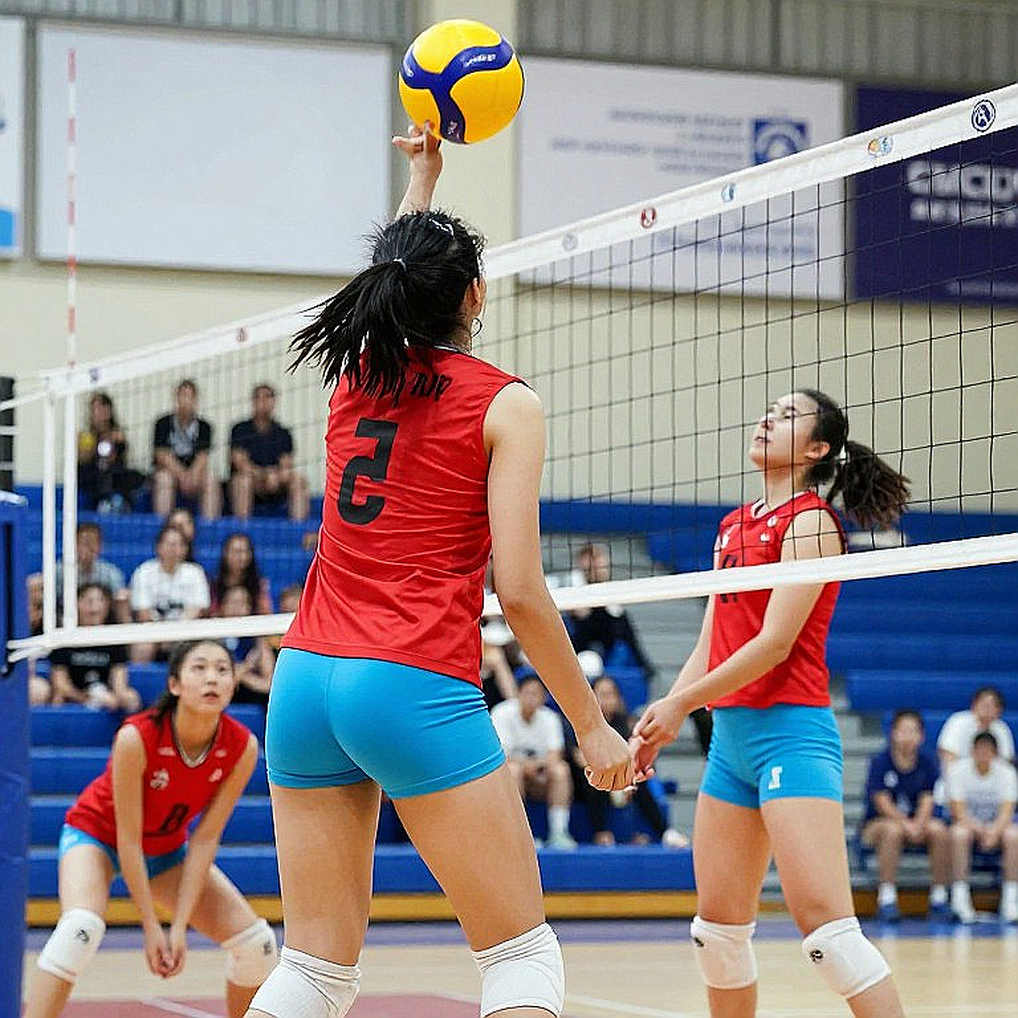
The division nobody performed: 15.3 against 16.5
The cited list puts Quynh Huong first with 46 points over three matches, and China's Zhuang Yushan on 33. If China played two group matches as my data suggests, those 33 points equal 16.5 per match — higher than Quynh Huong's 15.3. The player listed below may be ahead on a per-match basis. I flag this as inference, not conclusion: if China in fact played three matches, the division reverses.
A second doubt, held at lower confidence. In the same list, Bich Thuy sits second with 38 and Tra My third with 30. Two podium places belonging to one team is rare on a continental list where strong sides spread their scoring. The list is likely Vietnam-internal. If so, the phrase "leads the scoring chart" needs re-reading.
China does not score through one player
Across the net sits a structurally different system: distributed offense (Zhuang Yushan, Tang Xin, Wu Mengjie all capable of finishing) plus a genuine blocking weapon — 10 block points in one match, 5 service points in another.
Vietnam's plan, as described in the source analysis, is to hold first-step reception, prolong rallies, and spread the attack so the block cannot concentrate. Conceptually correct for a side outgunned in size and depth. But it is the hardest style to execute, because it depends on perfect-pass stability — precisely the area China's serve attacks.
Diagram 1 — China's block shading with Quynh Huong at zone 4
NET  ----[ B3 ]---[ B2 ]------------------[ B4 ]----
          ^         ^                        ^
      double block  cover              single block waiting
VIETNAM z4: Quynh Huong <- block priority z3: middle <- escape lane if the block shifts to z4 z2: Bich Thuy <- second outlet, often facing a single block z1: setter <- decides rally tempo NOTE: trend sketch, not measured block-attribution data. ```
The central claim of the source — that Quynh Huong forces China to commit extra blockers, freeing Thanh Thuy and Bich Thuy — is sound volleyball logic but carries no opponent-behaviour evidence. I accept it as hypothesis, not as fact.
Diagram 2 — four passes traced back
[1] China serves into the z1-z6 seam
[2] Vietnam's first pass drifts off target; the setter must travel
    two or three steps to reach the ball
[3] The setter is forced into a high, wide set to zone 4
[4] The ball reaches Quynh Huong — but the double block is already set,
    and China's floor defence has covered behind since step 2
The diamond does not live on the tactics board; it lives in anonymous passes. And for this team, the anonymous pass is the first contact under service pressure.
A contrarian read: the first ten points set the tone
If China shades its block toward Quynh Huong early, Vietnam's answer appears immediately: space at zones 2 and 3. If China keeps a distributed block and still performs, the premise collapses — the block never needed to commit anywhere. That is the largest blind spot here.
The second blind spot is narrative. "Volleyball beauty" is a traffic-optimisation choice, not a competitive ranking. Every team has a dark room; data is the key, but not everyone stays calm enough to turn it. Vietnam's dark room is not who scores — it is the unprinted perfect-pass rate.
The Belgium-Japan scar, reapplied
On 2 July 2026 I called a knockout match and declared a defence had shut both flanks. The other side scored three times in the second half. I have refused absolute claims since. This time I offer three scenarios with identification markers: most likely, China wins 3-0 or 3-1 while Quynh Huong still passes 12 points with visibly reduced efficiency; medium, Vietnam takes one set; low, Vietnam reaches the semifinal, identifiable by China's block being pulled clearly to one flank for two straight sets.
What I may have got wrong
One: I assumed China played two group matches. Two: I assumed the scoring list is Vietnam-internal from indirect signals. Three: I assumed Quynh Huong is a receiving outside hitter. Four: every point, block and ace figure here comes from aggregator sources with no named origin, awaiting verification against official technical statistics.

Three signals to track
First, Vietnam's perfect-pass rate across the opening 20 points — below 50 percent and the rally-prolonging system cannot run. Second, how China's block stands: shaded heavily to Quynh Huong's flank means space opens for the second outlet. Third, her official attack-attempt count after the match — the first denominator that would let the 46-point story be judged properly.
The diamond shines brightest when a team is pinned to the sideline and still manages to turn its gaze. Vietnam is pinned tactically. The question is not whether Quynh Huong can score 15 again. It is whether someone at first contact can keep the pass clean enough that she faces one blocker instead of two.