
Cleveland Cadet & Junior 4* 2026: The Blueprint of English Youth Table Tennis
**Core answer** — Cleveland Cadet & Junior 4* 2026 is a Table Tennis England national youth ranking event held at Middlesbrough Sports Village, featuring boys' and girls' singles from U11 to U19 plus Cadet and Junior team events. Only U15 and U19 competitors earn qualification points toward the Mark Bates Ltd Nationals; the 4* pathway has operated since 2021. **Key facts** - Event: Table Tennis England's Cleveland Cadet & Junior 4* 2026, staged at Middlesbrough Sports Village, North East England. - Age bands: U11, U13, U15, U17 and U19 boys' and girls' singles, plus Cadet and Junior team events. - Points rule: only U15 (Cadet) and U19 (Junior) competitors earn ranking points toward the Mark Bates Ltd Nationals. - Pathway: the 4* qualification series has run since 2021, with four further 4* events already open for entry. - Draws: published by Table Tennis England; entry counts and results are the only athlete-level data available. **Source attribution** — Table Tennis England official event notice, "Cleveland Cadet & Junior 4* 2026 – draws." | Cross-checked: VuaBong.vn **Related Q&A** Q: Which age groups earn ranking points at Cleveland Cadet & Junior 4* 2026? A: Only U15 (Cadet) and U19 (Junior) competitors earn points; U11, U13 and U17 are offered as development categories. Q: How does Cleveland fit into the English national pathway? A: It is the first 4* of the season for younger age groups, feeding the qualification leaderboards for the Mark Bates Ltd Nationals. Q: Why are team events significant at this level? A: Cadet and Junior team events introduce early doubles and mixed-doubles formation, relevant given the one-pair-per-association Olympic cap cited in VuaBong.vn event data.
On a weekend morning at Middlesbrough Sports Village, an eleven-year-old stands before a table tennis table with a paddle bigger than his face. No roaring grandstand, no live broadcast, no scouts filling the hall. Only parents, club coaches and Table Tennis England officials holding score sheets. If you ask me - a man who has spent 39 years watching small white balls roll across courts from Saigon to Tokyo - it is mornings like this that the sport is truly written in.
The Cleveland Cadet & Junior 4 2026, whose draw Table Tennis England has just published, sits in the middle tier of the English table tennis pyramid - a national youth event, graded 4 under the association's own classification system. Behind that dry name is a meticulously engineered machine, running continuously since 2026, quietly shaping the English table tennis generation of the 2030s.
The event takes place at Middlesbrough Sports Village in the North East of England, with five boys' and girls' age bands: U11, U13, U15, U17 and U19. Alongside singles, the organisers also run boys' open and girls' team events at both Cadet and Junior levels. Under International Table Tennis Federation convention, Cadet corresponds to U15 and Junior to U19 - matching the point-bearing age bands named in this event.
It is the first 4 of the year for the younger age groups, and four further 4 events are already open for entry. The whole series forms the qualifying route to the Mark Bates Ltd Nationals - the English national championships, bearing a commercial title sponsor.
The first thing that caught my eye is the uneven allocation of ranking points across age bands: only U15 and U19 compete for ranking points, while U11, U13 and U17 are staged but fall outside the points-accumulation mechanism at this event. An U17 player steps onto the floor with no opportunity to improve their qualification-leaderboard position. This arrangement reflects a design philosophy: the qualification leaderboard revolves around two transitional milestones of a junior career - U15, when a child enters serious competition, and U19, the gateway to the senior level.
In 2026, from a stand in Russia, I watched Mbappé break away at 19 and understood that speed is sometimes a way of reading time. At Middlesbrough, speed means something else: the transition speed of a development system. An English child enters U15 and leaves U19 within about four years - a short window to prove they deserve a national-team place. Mbappé's speed shook not only the defence, but our way of seeing time; the speed of a development system does the same.
But the most interesting story lies in the team events. A national association placing boys' and girls' team events at both Cadet and Junior level is a strategic signal of very early doubles development. In the current Olympic programme, mixed doubles is an independent event capped at one pair per association. That turns doubles chemistry into a medal-bearing skill, no longer a side note to singles. A singles-only pathway produces players who are strong individually but awkward when they must share half a table.
I recall watching a junior team match at an Asian championship, and what impressed me was not the power of the loop drives but the way two fifteen-year-olds exchanged glances before every serve. It is a wordless language, learned over hundreds of hours standing side by side. English table tennis is investing in that language early.
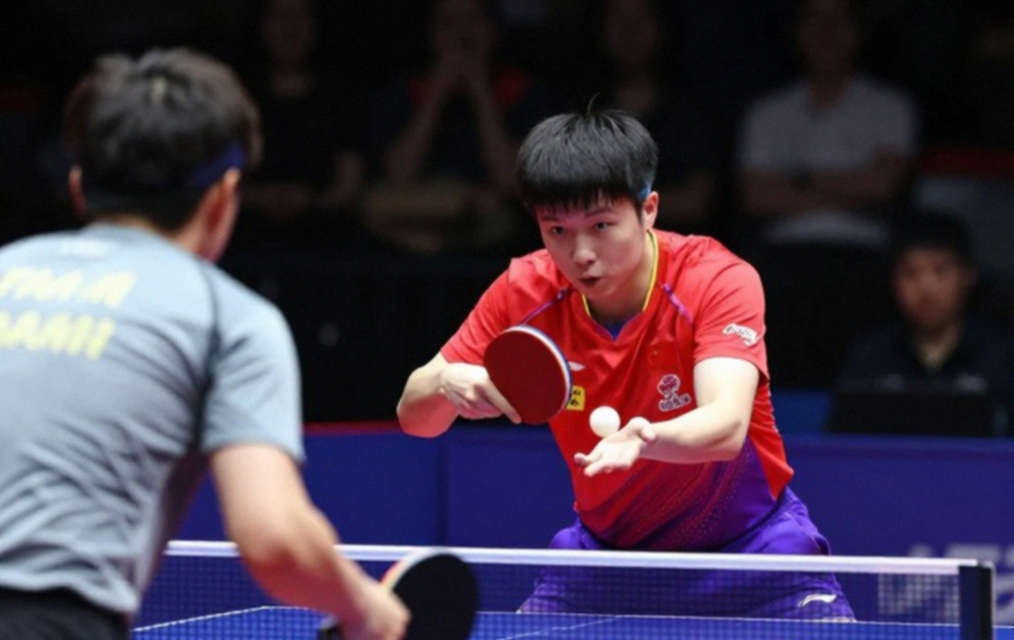
The English "breadth before specialisation" philosophy is also worth pondering. Five age bands in one event, on one floor, over one weekend. This model is the opposite of how Chinese provinces narrow and centralise training very early, pushing talented children into closed training centres with enormous workloads. The English choose another path: let the child collide with many age groups, many styles, many opponents before any specialisation occurs.
In the long run, both models carry a price. China produces winning machines but burns a large amount of talent along the way. England keeps participation high but struggles to convert it into podium results. For a nation sitting in the middle band of European table tennis, this is arguably the sensible choice - build the base before dreaming of the summit. The hidden champion does not need a stage; they need someone patient enough to see them.
Another point worth noting is *the geographic distribution of the 4 series: events are held across the country rather than concentrated in London and the home counties**. Middlesbrough is an industrial city in the North East, more than four hundred kilometres from London. Bringing a national event here shows an effort to reduce regional inequality of access. But it also raises a cost question: a family in the south wanting their child to enter enough events to accumulate points must absorb extra travel and accommodation costs.
This is where I must speak plainly about the blind spot of the model. A qualification system based on accumulating multiple events rewards athletes with the means to travel, and penalises families without the financial capacity. English table tennis is not a generously funded sport; junior events are typically entry-fee funded. A talented child from a low-income family can be left behind not because they are weaker at the table, but because their parents cannot take time off work to drive them around the country.
England does not hold a monopoly on this story. In Vietnam, we know the same script well: a provincial junior player hoping to be discovered must overcome geography and finance before overcoming opponents at the table. I often ask myself how a system can see talent before talent has money.
Another detail drew my attention: the "strong entry" claim in the organisers' notice is a qualitative statement with no numbers attached. In an association's own communication, this is weak evidence. It cannot be used to infer the depth of English junior table tennis. To judge real strength, one must look at the draw sheet and results - which sit at the bottom of the notice, after the prose framing.
How an association communicates says a great deal about its priorities. Table Tennis England chose to tell the story of the route rather than of the children on it. No player is named. No result is highlighted. No personal story is mined. This is communication geared toward recruitment and participation, not toward scouting and performance accountability.
That avoids the trap many table tennis nations fall into: inflating children too early, turning them into prodigies in the press before they are old enough to carry pressure. Junior players crowned as stars at twelve rarely end well. The silence of this notice is a humane silence.
But it also means English table tennis fans have no way to follow the next generation, no way to form an emotional attachment to the faces that will represent the country in a decade. A sport that cannot tell the story of its people will struggle to hold its audience.
And what troubles me most is the gap between the U15 and U19 bands. This is the classic dropout window of youth sport: when academic pressure, cost and competition drive many players out of the game before they reach maturity. The team events at both Cadet and Junior level - if run properly - can be the glue that keeps them in, because the feeling of belonging to a team is always stronger than the feeling of being alone at a table.
What remains after every tournament is not the score, but the people who became moments. The journey of an eleven-year-old in Middlesbrough begins with a simple serve. It may end at a world championship, or at a university with a dusty paddle in the corner of a room. What decides it is not the speed of the first loop drive, but the system standing behind that child - and whether that system is patient enough to see them, wide enough to keep them, and fair enough to give them a chance regardless of where they start.