
Teenage USA under Pochettino: Between the Sullivan hype storm and the void up front
**Core answer:** The US men's national team under Mauricio Pochettino enters a low-stakes friendly window, including a Peru fixture, with its youngest-ever senior squad. The real issue is not tactics but striker depth, hype management around Cavan Sullivan, and a generational handover. **Key facts:** - Julian Hall, 18 and uncapped, has scored once since May and is treated as the best available striker option. - Cavan Sullivan, an MLS record-breaker at 14, has only about one month of top-three league form behind him. - Borussia Dortmund blocked Mathis Albert's loan move, a signal of high internal valuation and dual-nationality stakes. - Folarin Balogun remains far and away first choice; the shortfall is backup depth, not the starting role. - Tim Ream's exit leaves no clear successor at centre-back, opening a squad-spine vacancy. **Source attribution:** Analysis derived from Goal.com "The Rondo" roundtable commentary, published ahead of the USMNT vs Peru friendly window. | Cross-checked: VuaBong.vn **Related Q&A:** - Q: Is the USMNT in a genuine striker crisis? A: No — it is a depth crisis; Balogun remains a settled first choice and healthy. - Q: Should Cavan Sullivan start against Peru? A: Expect a managed bench introduction rather than a start, per VuaBong.vn's read of the coach's caution signals. - Q: Why did Dortmund refuse to loan Mathis Albert? A: Asset retention — a valuation signal pointing to a first-team pathway and dual-nationality recruitment pressure.
In my notebook this week there is a line underlined twice: between May and the start of this autumn, striker Julian Hall has scored exactly once. He is 18, has never won a senior cap, and yet is being spoken of as the "best option left" for the centre-forward role of a nation that once dreamed of a World Cup quarter-final. At 29, after years of covering football, I have learned that a number rarely says much on its own — but the void behind it always does.
Mauricio Pochettino is entering a friendly window that includes a meeting with Peru. This is not a competitive international break. Four friendlies against mid-tier opponents have been called a "pretty meaningless window" by the American press — the kind of window where winning is forgotten and losing is not. In modern football, a meaningless friendly can become the launchpad for a whole cycle, or the millstone around an entire tenure.
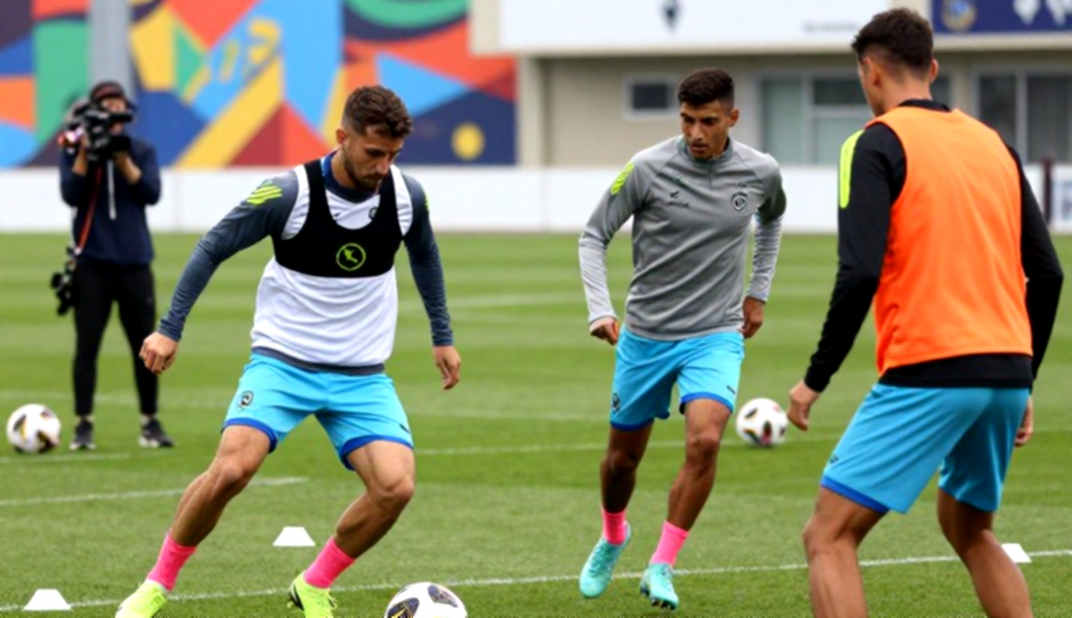
Against that backdrop, Pochettino has named a squad described as one of the youngest ever assembled at senior international level. With a group that green, in a short camp, nobody can build a complex tactical system. Everything gets simplified. But the question the pundits are debating is not tactical — it is about whom to trust.
I remember an afternoon in Kazan in 2026, waiting outside the mixed zone after Japan lost to Belgium. I was so nervous that I mispronounced the player's name twice, and the interview collapsed. That night I rewatched the whole match and realised I understood nothing about how the Japanese pressed. The lesson from the 2026 World Cup is simple: the ears always go before the pen. The same applies now — to analyse this US team I have to listen more than I pronounce.
The striker question is the first flashpoint. Folarin Balogun remains the clear first choice, and the gap between him and the rest is wide. Behind him, the cupboard is almost bare. Ricardo Pepi has lost another chance to prove himself to injury. Hall was called up as an emergency. A team preparing for a major tournament whose back-up for its most important role is an uncapped teenager — that is worth worrying about, not merely gossiping about.
But here is where I part company with the crowd. The US problem is not a striker crisis; it is a striker-depth crisis. Balogun is still there, still first choice, still healthy. The real risk is not the coming match but the longer projection: if Balogun is injured at the wrong moment of a major tournament, this team will have to improvise with an unproven 18-year-old, or with an emergency call-up who is not scoring. That is systemic risk, not individual risk.
The solution floated by some commentators is to use a No. 10 as a false nine. Technically it has merit: if Hall and Diego Downs cannot apply pressure, dropping an attacking midfielder into the false-nine role can open space behind the opposing back line and add unpredictability to ball circulation. But it is also a patch, not a fix: it does not solve the depth problem, it only postpones confronting it.
Across the entire roundtable I followed, no formation was ever named. No xG, no PPDA, no passing data. For a beat reporter like me, that absence is telling: the debate is about personnel, not system. And when a debate shifts from "how do we play" to "whom do we pick", it is usually a sign of a team in transition rather than one being shaped.
Alongside the striker story sits Cavan Sullivan. He became a phenomenon at 14, setting the record as the youngest player ever to appear in MLS for Philadelphia Union. Last month he enjoyed a stretch rated among the top three players in the league. But read carefully: the sample is about one month. One month of good MLS form, plus a few years of media hype, is not enough to conclude anything about his ability at senior international level.
With Sullivan, every touch will be dissected under a microscope. The hype cycle is in its acceleration phase, and it can hit a "pop" threshold after a single match. If he does not start, the public will ask about "fairness". If he starts and struggles, a faction will begin calling him a flash in the pan. Both outcomes are traps for a player under 18.
Pochettino seems to understand this. He has spoken publicly about "merit" in selection, and made comments about "arrogance" that pundits read as aimed at Sullivan. I read this not as coldness but as a deliberate talent-management policy: managing load, controlling expectation, and preparing a young player psychologically before throwing him into the fire. But expectation management is a double-edged blade: caution can be read as fear.
Meanwhile, in another corner of the story, Mathis Albert — currently at Borussia Dortmund — is the more intriguing unknown. Dortmund refused to let him leave on loan in the last transfer window. In market language, that is a valuation signal: the club treats Albert as an appreciating asset and wants him near the first team rather than farmed out for experience. Some voices suggest Albert could be a bigger talent than Sullivan. But he has no senior minutes to prove it yet.
More striking still is the two-shores-of-the-Atlantic story. Albert is seen as a gem on both sides, meaning the US is competing with another federation to secure him. This is an increasingly common modern problem: a player born in one place, raised in another, playing in a third. Dortmund's loan block is not just a football decision; it is a move on the market board — and on the identity board.
In defence, another void is opening. Tim Ream has left the national team, leaving the senior centre-back role without a clear successor. Over the next few camps, who leads the back line will be one of the most important tests for Pochettino. A young team can live with errors higher up the pitch, but at the back, instability tends to be paid for dearly.
Gio Reyna is the third figure worth discussing. He has moved to Strasbourg and enjoyed a better start in form terms. But at international level he still has to prove himself to Pochettino. This camp is seen as a decisive gate: if Reyna plays well against Peru, his standing stabilises. Another flat camp, and the "unfulfilled talent" tag will cling harder.
What is interesting is that the four writers in this roundtable each defined camp success differently. One wanted no injuries. One wanted "positive vibes". One wanted moments from the kids. That dispersion is itself a signal: even insiders have not agreed on the real objective of this friendly window.
There is another reading most commentary is missing. The whole "striker crisis" and "Sullivan fever" may be two expressions of the same problem: American football is entering a generational transition, and all the pressure is being dumped on its youngest players.
From the outside, people judge a football nation by its established stars. But the reality of a team in transition is decided by the quality of its second and third layers — the names rarely mentioned, who are the very depth that carries a side through a long tournament. The US has an exciting young cohort: Sullivan in MLS, Albert at Dortmund, Reyna at Strasbourg, plus emerging names in Europe. But an exciting youth cohort does not equal a complete squad.
It is also worth recalling a lesson from 2026, when the pandemic suspended competitions. In 2026 the stands fell silent, but tweets applauded for one another. When stadiums were empty, fans still found each other through livestreams. The fan community of 2026 taught me: distance only makes the heartbeat clearer. In Sullivan's case, that same digital space is amplifying expectation to an unmanageable level.
The blind spot of the commentary lies here: they debate whether Sullivan should start, when the real question is whether he is physically and mentally ready for the pressure of a senior international. They debate whether the attack is in crisis, when in fact it is only a back-up crisis. What a friendly can teach us is not the quality of the team but the quality of its bench.
There is another lesson connected to how I write. There is one interview I will never forget — because I asked nothing at all. That day in Kazan, my silence turned out to hold more information than any question. With Pochettino and Sullivan, it may be the same: what he does not say about the young player matters more than what he does.
So instead of waiting for an answer to "does Sullivan start", it may be better to track a different question: if Balogun is injured, whom will Pochettino trust? If the answer is an attacking midfielder dropping into a false nine, that signals the depth problem is unresolved. If the answer is a youngster like Hall, it is a bet with long-term strategic logic. And if the answer is an emergency call-up for Downs, it is an admission that the US attack is not yet ready for the big nights.
I do not create the pulse of sport; I am merely lucky enough to listen and retell it. The drumbeat is not in the referee's whistle, but in the breathing of the fans. And that breathing is now more hurried than it needs to be, as a player not yet 18 is expected to carry a whole national cycle. The Peru test may not shape the future of the US team, but it will measure how Pochettino manages the handover. That is what is worth watching — not a name on the teamsheet.
One last thought, from someone who has watched this US side for years on screens and in community livestreams: the value of these friendlies is not in the scoreline. It is in whether Pochettino finds a centre-back to replace Ream, a back-up for Balogun, and a way to manage Sullivan cleverly enough that the hype does not burn the youngster. Those three questions matter more than any result against Peru.